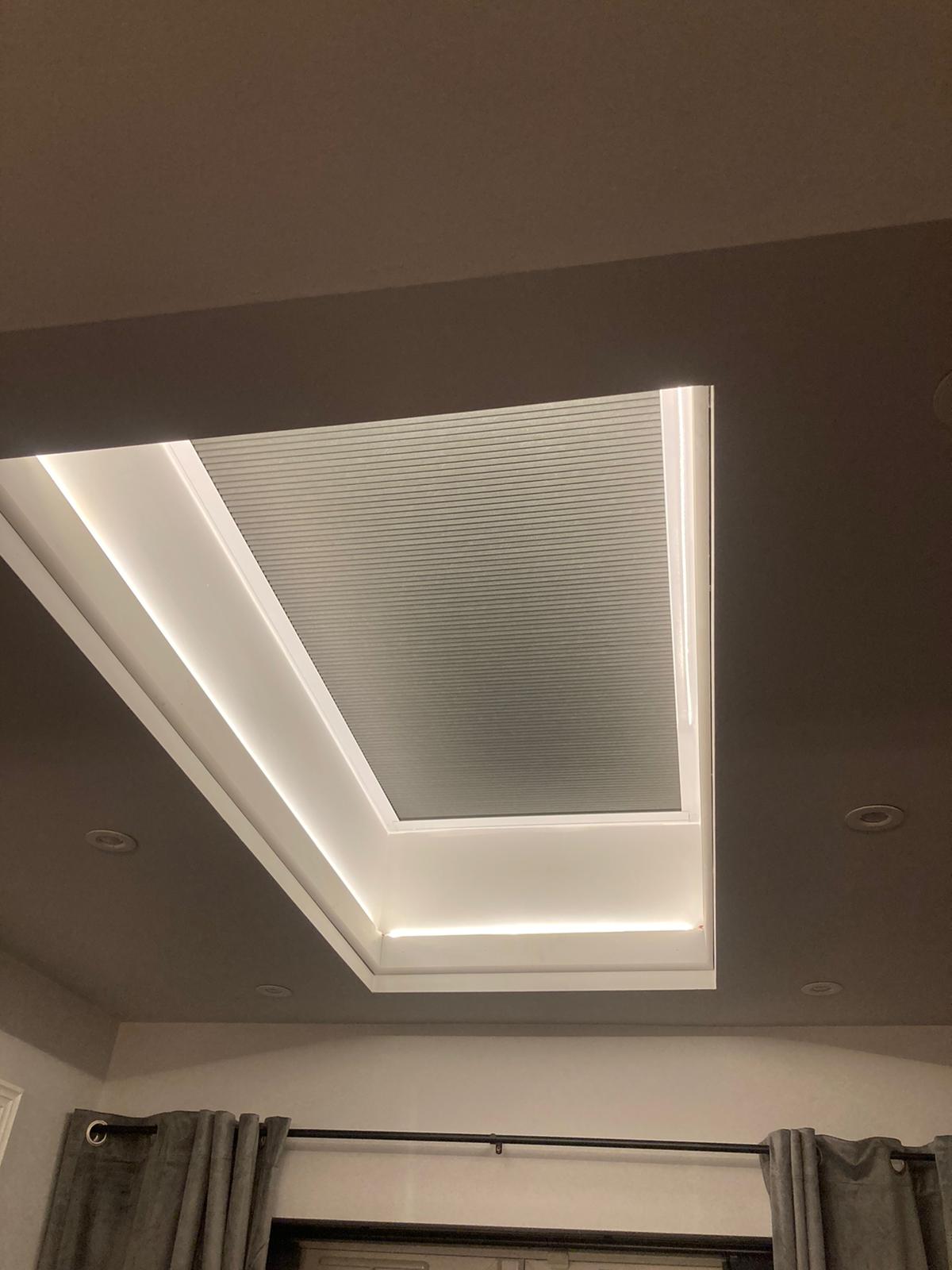
Manual or Motorised Roof Blinds? Two Customers, The Same Room, The Same Decision.
If you're choosing between a manually operated and a motorised cellular roof blind, here's the simple answer.
Both use exactly the same insulating honeycomb fabric, so both do an excellent job of reducing glare, keeping rooms cooler in summer and improving insulation during winter.
The real difference isn't performance.
It's how you'll live with the blind every day.
If you expect to leave it closed for most of the year, a manual blind offers exceptional value.
If you enjoy opening and closing your blinds regularly, the convenience of motorisation can make it well worth the extra investment.
Interestingly, I was reminded of this only last week.
Two Customers. One Road. Almost Identical Rooms.
Last week I visited two lovely ladies who live on the same road in Asfordby.
They both had almost identical garden room extensions built by the same company.
Both rooms had large south-facing roof windows.
Each skylight measured just under one metre wide and almost two metres long.
And both homeowners said exactly the same thing.
"We love the room... we just can't enjoy sitting in it on sunny afternoons."
It's something I hear surprisingly often.
People spend thousands creating a beautiful garden room, only to find the roof windows turn it into the brightest and often warmest room in the house.
Fortunately, the solution was straightforward.
Cellular roof blinds.
The interesting part wasn't choosing the blind.
It was deciding which cellular roof blind was the right one.
Two Blinds. The Same Fabric. Very Different Prices.
There were two options.
Option One – Manual Cellular Roof Blind
£221 per blind
This blind uses our insulating honeycomb fabric and is operated using a detachable pole.
Discreet guide wires support the blind across the sloping window, keeping the fabric perfectly in position.
It's simple.
Reliable.
And for many homeowners, it's excellent value.
Option Two – Solar-Powered Motorised ClearView Roof Blind
£947 per blind
This blind uses exactly the same honeycomb fabric.
That means both blinds perform very similarly when it comes to:
- reducing glare
- helping keep rooms cooler during summer
- improving insulation during winter
That often surprises people.
Many assume the more expensive blind must keep the room noticeably cooler.
In reality, the fabric is doing the thermal work in both systems.
So where does the extra money go?
Why Is One Blind Over Four Times the Price?
This is usually the point where customers stop me.
"So what exactly am I paying for?"
It's a fair question.
The additional cost isn't for better insulation.
It's for everything surrounding the fabric.
The motorised ClearView blind is:
- remote controlled
- solar powered
- completely wire free, with no mains wiring required
- designed with discreet side channels instead of guide wires, creating a much cleaner finish across the roof window.
In other words, you're paying for convenience and appearance rather than dramatically better thermal performance.
That's why I spend less time talking about price and much more time talking about how people actually use their room.
Feature |
Manual Cellular Roof Blind |
Solar Powered ClearView Roof Blind |
Typical Price |
£221 per blind |
£947 per blind |
Heat Reduction |
★★★★★ |
★★★★★ |
Winter Insulation |
★★★★★ |
★★★★★ |
Fabric Performance |
Same cellular honeycomb fabric |
Same cellular honeycomb fabric |
Operation |
Detachable operating pole |
Remote control |
Power Source |
None required |
Integrated solar charging |
Visible Guide Wires |
Yes |
No |
Side Channels |
No |
Yes (ClearView system) |
Appearance |
Functional and discreet |
Clean, premium finish |
Daily Convenience |
Requires operating pole |
Open and close at the touch of a button |
Best For |
Customers who mainly leave the blind closed |
Customers who regularly adjust the blind throughout the day |
Maintenance |
Very little |
Occasional battery charging via the integrated solar panel |
Overall Value |
Excellent value for fixed shading |
Premium solution for convenience and aesthetics |
The Question That Really Matters
After fitting roof blinds for many years, I've noticed something interesting.
Customers who choose manually operated roof blinds often end up leaving them closed for most of the year.
Once they discover how much cooler and more comfortable the room feels, they simply leave the blind down.
Choosing a light filtering fabric rather than blackout side allows light into your room.
If that's likely to be you, the manual blind is incredibly good value.
But these two customers both said something that completely changed our conversation.
They loved looking up at the sky.
They wanted to enjoy the extra daylight during winter.
They expected to adjust the blinds throughout the year rather than leave them permanently closed.
Then one of them smiled and said:
"I can already imagine getting fed up with that pole."
At that moment, the decision became much easier.
The motorised blind wasn't an unnecessary luxury.
It was the blind they were actually going to enjoy using.
There's No Right Answer Only the Right Blind for You
This is why we never begin by recommending a product.
Instead, we ask questions.
- How do you use the room?
- Will the blinds stay closed most of the time?
- Will you open them every day?
- Is appearance important to you?
- Would using an operating pole become frustrating over time?
Sometimes those answers lead us to recommend the £221 manual blind.
Sometimes they lead us to recommend the £947 solar-powered ClearView system.
Neither recommendation is better.
They're simply designed for different lifestyles.
Our Recommendation
If your main goal is controlling heat and glare, and you're happy leaving the blind closed for extended periods, a manually operated cellular roof blind offers outstanding value while delivering the same excellent insulation as a motorised system.
If you know you'll regularly adjust the blind, enjoy looking through your roof windows, appreciate a cleaner appearance and value the convenience of remote control, the solar-powered ClearView blind is a worthwhile investment.
The best roof blind isn't necessarily the most expensive one.
It's the one you'll still be happy using every single day, years from now.
My Verdict
If this sounds like you... |
We'd usually recommend... |
"I mainly want to stop the room overheating." |
Manual Cellular Roof Blind |
"I'll probably leave the blinds closed most of the summer." |
Manual Cellular Roof Blind |
"I want to see the sky whenever I choose." |
Solar Powered ClearView Roof Blind |
"I don't want to use an operating pole every day." |
Solar Powered ClearView Roof Blind |
"The room is used every day and convenience matters." |
Solar Powered ClearView Roof Blind |
"I want the cleanest possible appearance with no support wires." |
Solar Powered ClearView Roof Blind |
What You're Actually Paying For
Your Money Goes Towards... |
Manual |
Solar ClearView |
Cellular insulating fabric |
✅ |
✅ |
Keeping the room cooler |
✅ |
✅ |
Helping retain heat in winter |
✅ |
✅ |
Remote control |
❌ |
✅ |
Solar charging |
❌ |
✅ |
No visible guide wires |
❌ |
✅ |
Premium appearance |
❌ |
✅ |
Everyday convenience |
Good |
Excellent |
Frequently Asked Questions
Do manual and motorised roof blinds keep rooms equally cool?
Yes. When both use the same cellular honeycomb fabric, they provide very similar thermal performance. The main difference is how the blinds are operated.
Are motorised roof blinds mains powered?
Not necessarily. Our premium ClearView roof blinds are solar powered, so there's no need to install electrical wiring to the roof window.
Why do manual roof blinds have guide wires?
Guide wires support the blind on sloping roof windows and prevent the fabric from sagging under its own weight.
Are ClearView roof blinds completely wire free?
Yes. Instead of guide wires, the fabric travels inside discreet side channels, creating a cleaner, more contemporary appearance.
Which roof blind offers the best value?
That depends on how you'll use it. If you're happy leaving the blind closed most of the time, the manual system offers exceptional value. If you'll be opening and closing it regularly, most homeowners feel the convenience of a motorised blind justifies the additional investment.
About Phil Coleman
Phil Coleman is the fifth generation of his family to run Barlow Blinds, a Leicester business that has been making blinds since 1887. With over 30 years of hands-on experience, Phil has played a leading role in shaping industry standards including being part of the team that wrote the only NVQ qualification for blind and shutter installers. He also serves on the Management Committee of the British Blind & Shutter Association (BBSA), helping to set best practice across the trade. Under his leadership, Barlow Blinds has remained true to its founding principle: “It’s not our job to find customers for our blinds, it’s our job to find the right blinds for our customers.”
Article Review & Accuracy
Reviewed by: Phil Coleman, Managing Director, Barlow Blinds
Last reviewed: July 2026
Our promise
If new evidence, products or British Standards change our advice, we'll update this article. If we make a mistake, we'll correct it.
This article forms part of the Barlow Blinds Knowledge Centre and is written or personally reviewed by Phil Coleman, drawing on more than 35 years' experience, guidance from the British Blind & Shutter Association (BBSA), British Standards where applicable, manufacturer technical information and real customer feedback.
Major updates to this article are shown at the top or bottom of the page.