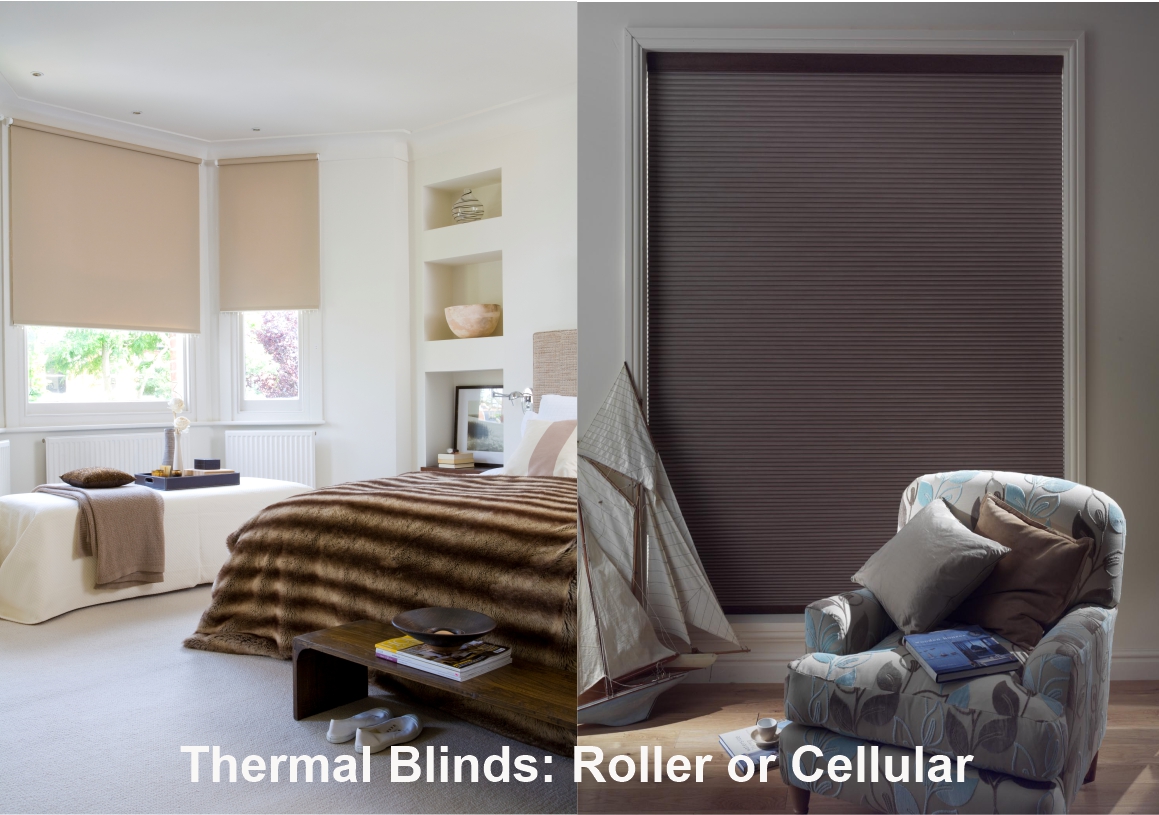
Can a Roller Blind Really Be Called a Thermal Blind?
I was standing in a customer’s kitchen this morning, quoting for three motorised roller blinds across a set of bifold doors.
We’d pretty much got the fabric sorted. They liked a light-filtering roller fabric, we’d talked through how the blinds would operate, and everything was fairly straightforward.
Then they said something that changed my recommendation completely.
“We need a thermal fabric because we lose a lot of heat through these doors in winter.”
Now, I could have simply nodded and started talking about thicker roller fabrics.
But I think this is where we need to be careful with the word thermal.
Because will a roller blind help reduce heat loss?
Yes.
Would I sell you one as the best thermal blind if keeping heat in was one of your biggest priorities?
No.
And there’s an important difference between those two things.
Will a Roller Blind Help Keep Heat In?
Yes, it can.
Almost any blind covering a window creates an additional barrier between the warm room and the cold glass.
Testing carried out for the British Blind & Shutter Association at the University of Salford’s Energy House demonstrated that blinds can reduce heat loss through windows.
For more information about the BBSA winter tests click here
In those tests, a standard roller blind reduced heat loss by around 13%.
So if somebody asks me:
“Does a roller blind have a thermal benefit?”
My answer is yes.
But if they ask:
“Is a roller blind the best blind to choose because I’m losing lots of heat through my windows?”
That’s a different question.
And I’d give them a different answer.
“But I’ve Seen Thermal Roller Blinds Online”
That was exactly what the customer said to me.
“I’ve seen thermal roller blinds advertised online. Don’t you do them?”
And I completely understand why they asked.
Search online and you’ll find plenty of roller blinds described using words such as thermal, energy-saving and insulating.
There is some justification for that.
Put a blind in front of a window and it can help reduce heat loss. A thicker or blackout roller fabric may also perform differently from a lightweight fabric.
So I’m not suggesting that every company using the term “thermal roller blind” is somehow being dishonest.
My concern is slightly different.
If you come to me and say:
“Heat loss is one of my biggest problems. What type of blind would you recommend?”
I don’t think I should simply find a way of putting the word thermal in front of the blind you already had in mind.
I should explain what your options are.
And in this case, that meant talking about cellular blinds.
If Heat Retention Is the Priority, I’d Look at Cellular Blinds
In the same BBSA testing, cellular blinds produced a much greater improvement in heat retention — around 32%.
Why the difference?
It comes down to how the blind is constructed.
Look at a cellular blind from the side and you’ll see a series of honeycomb-shaped cells.
Those cells trap pockets of air inside the blind, creating an insulating layer between the room and the window.
That’s very different from simply taking a roller blind and using a thicker piece of fabric.
So when somebody tells me:
“My biggest priority is keeping more heat in during winter,”
cellular is the product I immediately want to discuss.
That doesn’t automatically mean it’s the blind they should buy.
But I think they should at least know it exists before making the decision.
You Don’t Have to Make the Room Dark Either
This mattered in this particular kitchen.
The customers wanted to improve heat retention, but they also wanted plenty of natural light.
They didn’t want to solve one problem and create another by making the kitchen unnecessarily dark.
This is another misconception worth clearing up.
A cellular blind doesn’t have to be blackout to benefit from its honeycomb construction.
You can choose a light-filtering cellular fabric that allows natural light into the room while still having those insulating cells within the blind.
For these bifold doors, we could also have supplied cordless cellular blinds, so there wouldn’t have been loose operating cords hanging around the doors.
And cellular fabric isn’t limited to one particular style of blind.
Depending on the window or door, we can use cellular fabrics in cordless blinds, Perfect Fit blinds, bifold door blinds and roof lantern blinds, with both blackout and light-filtering options available.
The operating system might change.
The important bit, when we’re talking about insulation, is the cellular construction.
There Was Just One Problem
They didn’t like them.
Not the performance.
Not the way they operated.
They simply preferred the look of roller blinds.
And that’s absolutely fine.
Because this is the bit that sometimes gets forgotten when we talk about which product is “best.”
Best for what?
If we’re talking purely about improving heat retention based on the testing, I’d be pointing them towards cellular.
But these blinds were going across a large set of bifold doors in their kitchen.
They were going to look at them every single day.
How the blinds looked mattered too.
So eventually the decision became quite simple:
Which mattered more to them having the appearance of the roller blind they preferred, or choosing the blind that offered the greater improvement in heat retention?
There wasn’t a wrong answer.
There was just a compromise they needed to understand.
We Didn’t Get the Order
In the end, they chose another company.
That company was describing its roller blinds as thermal roller blinds, which gave them the combination they wanted: the appearance of a roller blind and a product being sold as thermal.
And I’m genuinely comfortable with losing the order.
Could I have called one of our roller blinds thermal?
Perhaps.
A roller blind creates another layer at the window, and the independent testing demonstrates that roller blinds can reduce heat loss.
But that wasn’t really the question the customers had asked me.
They had told me that heat retention was one of their most important requirements.
Once I know that, I don’t think my job is to find the easiest way to sell them the product they originally asked for.
My job is to say:
“If heat retention is genuinely your priority, there’s another type of blind I think you should consider before you decide.”
Sometimes the customer will look at the alternatives and still choose the roller blind.
Sometimes, as happened here, they’ll buy from somebody else.
That’s part of giving honest advice.
So, Can a Roller Blind Really Be Called a Thermal Blind?
This is where I’d land.
Roller blinds can help reduce heat loss.
Independent testing supports that.
Some roller fabrics and installations may perform better than others, and putting a roller blind at a window can certainly provide a thermal benefit.
So I don’t have a problem with somebody saying a roller blind can help with heat retention.
Where I become more cautious is when “thermal blind” starts to suggest that a roller blind is necessarily the best option for somebody whose main concern is keeping heat inside their home.
Because that isn’t the advice I’d give.
If you asked me:
“What type of blind should I be looking at if keeping heat in during winter is my number one priority?”
I’d be showing you cellular blinds.
Not because they’re the newest product.
Not because I particularly want to sell you one.
And not because you have to choose them.
I’d show them to you because the honeycomb construction is designed to trap air and the independent testing gives me a good reason to put them into the conversation.
Then you might look at them and say:
“I still prefer roller blinds.”
Fair enough.
At least now you know what you’re choosing between.
FAQs about Thermal Blinds
Are roller blinds thermal?
Roller blinds can provide a thermal benefit because they add another layer between the room and the window. In the BBSA testing discussed above, a standard roller blind reduced heat loss by around 13%. However, if heat retention is your main priority, I’d also consider cellular blinds because they performed substantially better in the same testing.
Are blackout roller blinds better for keeping heat in?
A thicker or blackout roller fabric may offer advantages over a lightweight fabric, but I wouldn’t choose a blind based on the word “blackout” alone if insulation is your main concern. The construction of the blind, how it fits at the window and the fabric all matter.
Do cellular blinds have to be blackout to keep heat in?
No. You can choose a light-filtering cellular fabric and still benefit from the honeycomb construction that traps pockets of air within the blind. That can be particularly useful in kitchens and living spaces where you want to retain natural light.
What are the best blinds for keeping heat in during winter?
If heat retention were one of your main priorities, cellular blinds would be one of the first options I’d discuss with you. Their honeycomb construction traps air, and in the BBSA testing referenced in this article, cellular blinds reduced heat loss by around 32%, compared with around 13% for a standard roller blind.
Because our job isn’t to tell you which blind you have to buy.
It’s to explain the differences honestly including the compromises so you can decide what matters most in your own home.
About Phil Coleman
Phil Coleman is the fifth generation of his family to run Barlow Blinds, a Leicester business that has been making blinds since 1887. With over 30 years of hands-on experience, Phil has played a leading role in shaping industry standards including being part of the team that wrote the only NVQ qualification for blind and shutter installers. He also serves on the Management Committee of the British Blind & Shutter Association (BBSA), helping to set best practice across the trade. Under his leadership, Barlow Blinds has remained true to its founding principle: “It’s not our job to find customers for our blinds, it’s our job to find the right blinds for our customers.”
Article Review & Accuracy
Reviewed by: Phil Coleman, Managing Director, Barlow Blinds
Last reviewed: September 2026
Our promise
If new evidence, products or British Standards change our advice, we'll update this article. If we make a mistake, we'll correct it.
This article forms part of the Barlow Blinds Knowledge Centre and is written or personally reviewed by Phil Coleman, drawing on more than 35 years' experience, guidance from the British Blind & Shutter Association (BBSA), British Standards where applicable, manufacturer technical information and real customer feedback.
Major updates to this article are shown at the top or bottom of the page.