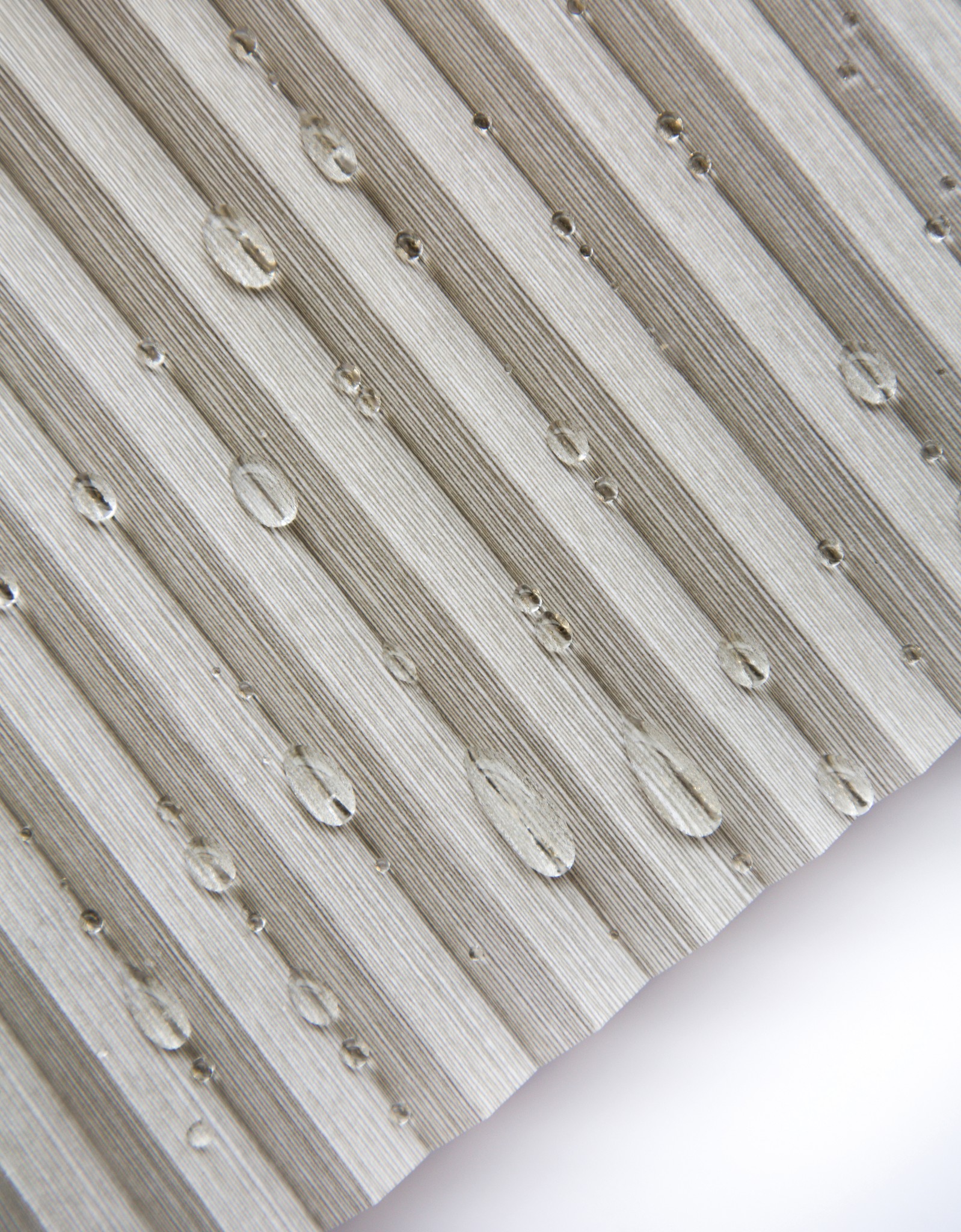
A Small Comment About Condensation Changed Our Conversation About Conservatory Blinds
I was in Scraptoft recently measuring for conservatory roof blinds when the customer made a fairly casual comment.
“We suffer from a little condensation from time to time.”
It would have been very easy to brush past it.
But those few words changed the conversation we were having about which blinds might be right for her conservatory.
And, interestingly, they led us to an option nobody else she'd spoken to had mentioned.
We’d Been Talking About Pleated and Cellular Blinds
Up until that point, it had been a fairly typical conversation.
We were looking at the differences between pleated and cellular fabrics and talking about why cellular blinds have become such a popular choice for conservatories.
Cellular fabric has a honeycomb construction that traps air within the blind.
That can help reduce heat loss through the glazing during colder weather and reduce unwanted solar heat entering the room during warmer weather.
There’s also a noticeable difference in appearance.
With traditional pleated roof blinds, you can normally see the small holes where the support wires pass through the fabric.
With cellular fabric, those wires can run through the internal cells instead.
No visible holes through the face of the fabric.
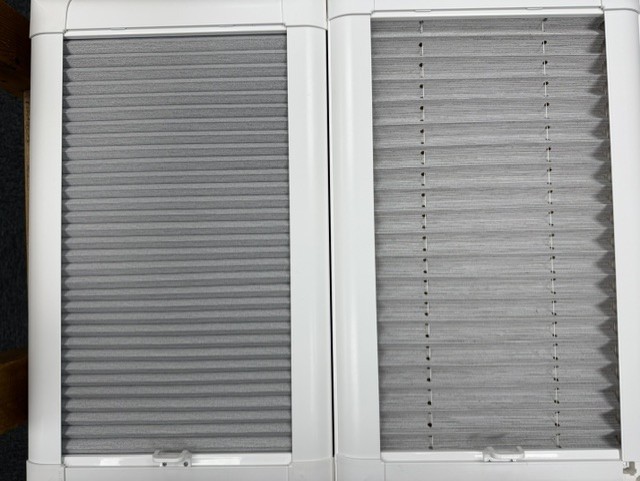
For plenty of customers, that cleaner appearance alone is enough to make cellular their preferred option.
And then she mentioned the condensation.
“How Much Is a Little?”
That was my next question.
Because “we get a little condensation” can mean very different things in different homes.
Are we talking about a small amount of moisture appearing occasionally on particularly cold mornings?
Or are the windows regularly wet, with enough condensation that moisture could potentially come into contact with the blinds?
That distinction matters.
Most of the cellular fabrics we use are polyester, so a small amount of occasional moisture isn't necessarily something I'd be concerned about.
But if condensation is more regular or there's any doubt about how much moisture the blind might encounter there's another option worth knowing about.
Waterproof cellular fabric.
The colour range is a little more limited than our standard cellular collection.
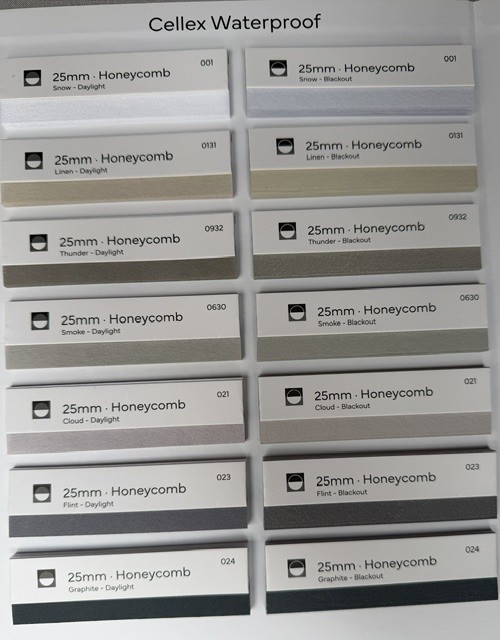
But if I'm looking at a conservatory where condensation could regularly be an issue, I'd rather have that conversation with the customer before the blinds are ordered than afterwards.
Her response surprised me.
“No one else has mentioned waterproof fabrics.”
She'd already been discussing conservatory blinds elsewhere, but nobody had raised it as an option.
Then came the question I suspect many of us would ask next.
“Are they more expensive?”
No.
Our waterproof cellular fabrics are the same price as our regular cellular fabrics.
There Was Nothing Extra for Me to Sell Her
I think that's the part of today's conversation that's worth sharing.
You've mentioned a problem.
Someone suddenly recommends a different product.
It's perfectly reasonable to wonder whether you're about to be sold an upgrade.
But there wasn't an upgrade here.
There wasn't a more expensive blind I wanted to move her towards.
I'd simply learned something about her conservatory that meant one fabric might be better suited to it than another.
Had she not mentioned condensation, we could quite easily have carried on talking about colours, thermal performance and how the finished blinds would look.
But she did mention it.
And once I knew moisture might be an issue, waterproof fabric became part of the conversation.
Sometimes that's all it takes.
One apparently insignificant comment can change the recommendation.
The Questions Matter as Much as the Measurements
When I visit somebody's home to measure for made-to-measure blinds, obviously I need accurate dimensions.
But measurements only tell me so much.
I also want to understand how that room actually behaves.
Does the conservatory become unbearably hot when the sun comes out?
Does it lose too much heat during winter?
Is glare making the room uncomfortable?
Do you need more privacy?
How do you actually use the space?
And, after today's visit, here's another good one:
Do you get condensation?
Those questions aren't small talk.
The answers can affect the type of blind or fabric I'd recommend.
And that's why I don't think choosing made-to-measure blinds should simply be a case of somebody saying, “I want cellular blinds,” and us measuring the windows and supplying them.
The job is to understand why you're buying the blinds and what problems you're hoping they'll solve.
Then we can talk about what actually makes sense for your room.
I've been measuring and fitting blinds for more than 30 years, and visits like today's are a good reminder that you never stop asking questions.
Because sometimes the most useful piece of information isn't something you measure with a tape measure.
It's something the customer mentions almost in passing.
Today, it was condensation.
And those few words potentially led to a better solution without costing her a penny more.
Frequently Asked Questions About Conservatory Blinds and Condensation
Can condensation damage conservatory blinds?
An occasional small amount of condensation isn't necessarily a problem for the polyester fabrics we use. However, if your conservatory regularly suffers from heavier condensation and moisture could come into contact with the blinds, it's worth discussing this before choosing your fabric.
Are cellular conservatory blinds waterproof?
Not all cellular fabrics are waterproof. We offer both standard cellular fabrics and waterproof cellular fabrics, so if condensation or moisture is a concern, make sure you mention it when discussing your blinds.
Are waterproof cellular blinds more expensive?
Not with us. Our waterproof cellular fabrics are the same price as our regular cellular fabrics, so choosing waterproof fabric because of condensation doesn't mean paying for an upgrade.
Do waterproof cellular blinds come in the same colours?
The waterproof cellular range has a more limited choice of colours than our standard cellular collection. If moisture resistance is important, we'll show you the available options so you can weigh that against your preferred colour and finish.
About Phil Coleman
Phil Coleman is the fifth generation of his family to run Barlow Blinds, a Leicester business that has been making blinds since 1887. With over 30 years of hands-on experience, Phil has played a leading role in shaping industry standards including being part of the team that wrote the only NVQ qualification for blind and shutter installers. He also serves on the Management Committee of the British Blind & Shutter Association (BBSA), helping to set best practice across the trade. Under his leadership, Barlow Blinds has remained true to its founding principle: “It’s not our job to find customers for our blinds, it’s our job to find the right blinds for our customers.”
Article Review & Accuracy
Reviewed by: Phil Coleman, Managing Director, Barlow Blinds
Last reviewed: September 2026
Our promise
If new evidence, products or British Standards change our advice, we'll update this article. If we make a mistake, we'll correct it.
This article forms part of the Barlow Blinds Knowledge Centre and is written or personally reviewed by Phil Coleman, drawing on more than 35 years' experience, guidance from the British Blind & Shutter Association (BBSA), British Standards where applicable, manufacturer technical information and real customer feedback.
Major updates to this article are shown at the top or bottom of the page.