She Loved the Look of Wooden Blinds But Something Was Bothering Her
Mrs Allsop came into our Leicester showroom yesterday to finalise the blinds we'd measured for at her home.
We had visited her to measure a few days earlier, she'd chosen wooden Venetian blinds.
She loved the look of them. They'd give her the privacy she wanted and, by adjusting the slats, she'd be able to cut down the glare on the television.
But in the time between measuring and her coming into the showroom, she'd started having doubts.
Not about how the blinds would look.
It was the light.
"I'm Worried They're Going to Make the Room Too Dark"
This was the thing that had been niggling at Mrs Allsop.
She wanted privacy, particularly when the blinds were closed. She wanted to reduce the glare on the television too.
But she didn't want to solve those problems and end up sitting in a dark room during the day.
And that's a perfectly reasonable concern with wooden Venetians.
They're brilliant blinds when you want control over privacy and direct light. You can tilt the slats to suit you throughout the day.
But those slats are solid.
So when you close them for privacy, you're inevitably going to block more natural light.
That's when I showed Mrs Allsop another option.
Have You Seen a Fabric Venetian Blind?
A lot of people haven't.
Our Vela Fabric Venetians work in much the same way as a traditional Venetian blind. You've still got horizontal slats that you can tilt to control privacy and glare.
But there's one fairly important difference.
The slats are made from fabric rather than wood or fauxwood.
That means the light behaves very differently.
With a traditional wooden Venetian, closing the solid slats blocks a significant amount of light coming through the window.
With a Vela, the fabric can still allow softer, diffused natural light into the room.
So if you need to close your blind for privacy, you don't necessarily have to make the room feel dark to do it.
As we were talking, I realised I had something on my phone that would probably explain the difference better than I could.
I Had the Answer Sitting on My Phone
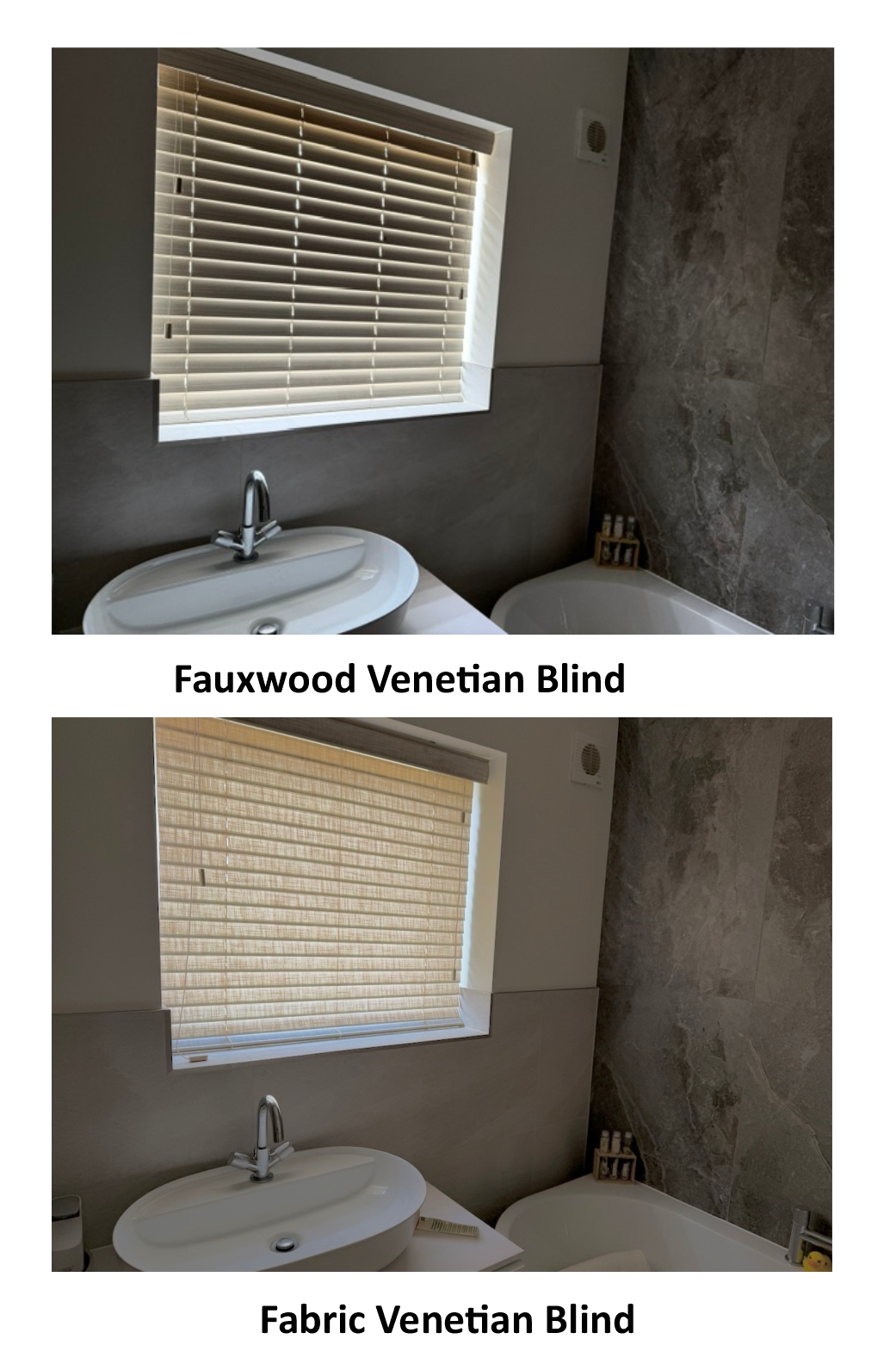
We'd actually faced a very similar decision in our own home.
Our bathroom used to have a fauxwood Venetian blind.
There was nothing wrong with it. It gave us the privacy we needed and did exactly what a Venetian blind is supposed to do.
But when it was closed, it blocked quite a lot of the natural light.
We eventually swapped it for a Vela Fabric Venetian.
Luckily, I had photographs of both on my phone.
So rather than keep trying to explain the difference to Mrs Allsop, I got my phone out and showed her.
The difference was immediately obvious.
Same window. Same need for privacy. Same basic Venetian style.
But a very different effect on the room.
The fauxwood gave us the solid Venetian look, but the Vela created a much softer, lighter feel when it was closed.
That's when it clicked for Mrs Allsop.
She could see that the fabric Venetian would give her the privacy she wanted and help with the television glare, without taking away as much of the natural light she was worried about losing.
And that's what she decided to go for.
But the Vela Is More Expensive
This is something I'd want you to know before assuming the Vela is automatically the better option.
Our Vela Fabric Venetians are typically around 20% more expensive than the equivalent wooden Venetian, although the exact difference will depend on the size and specification of your blinds.
Is that extra 20% worth paying?
For some people, absolutely.
For others, probably not.
If you love the appearance of real wood, want maximum control over the light coming into the room, or don't expect to have the blind closed very often during the daytime, I wouldn't tell you to spend more money on a Vela just because it's available.
A wooden Venetian could be exactly the right blind for you.
But Mrs Allsop's priorities were slightly different.
She wanted the Venetian look.
She needed privacy.
She wanted to reduce glare on the television.
But she also wanted to keep as much natural light in the room as she reasonably could.
For her, paying the extra solved the one concern that had been bothering her since I'd measured.
And that's what made it worthwhile.
Don't Ignore That Little Doubt After You've Chosen Your Blinds
There's another reason I wanted to share Mrs Allsop's story.
She hadn't made a bad decision when she originally chose wooden Venetians.
I'd measured for them. We'd discussed what she needed. They would have looked great and done most of what she wanted them to do.
She simply went away and thought about it some more.
And then that little doubt crept in:
"What if they're too dark?"
That happens.
You've got more time to think once we've left. You notice how the light comes into the room at different times of day. You start imagining what it'll be like with the blind closed. Or your other half asks a question you hadn't thought of when I was there.
That's why, if something starts niggling at you after we've measured, I'd much rather you ask us about it than convince yourself:
"Oh, it'll probably be fine."
Give us a call.
Come into the showroom.
Tell us what's bothering you.
There might be another option you didn't know existed.
And if the blind you've already chosen is still the best one for you, we'll tell you that too.
This Is Still One of the Most Important Parts of Our Job
One thing I've learned is that helping somebody choose a blind isn't really about telling them:
"This is the blind you should buy."
It's about understanding what they actually need the blind to do.
What matters most?
Privacy?
Natural light?
Reducing glare?
Making a room darker?
Keeping a particular look?
Staying within a certain budget?
Sometimes one small detail changes the answer completely.
That's exactly what happened with Mrs Allsop.
She didn't change her mind because wooden Venetians were the wrong choice.
She changed her mind because, once we understood that keeping the room feeling light was important to her, there was another blind that fitted her needs better.
Wooden or Fabric Venetian Blinds: Which Should You Choose?
If you're deciding between the two, don't start by asking which blind is "best."
Start by asking what you want it to do.
Wooden Venetians give you that classic solid-slat Venetian appearance, with excellent privacy and very good control over the amount of light entering the room.
Vela Fabric Venetians give you a similar Venetian style and privacy, but the fabric slats allow softer natural light to filter through when they're closed.
The trade-off is that the Vela typically costs around 20% more.
Neither is automatically better.
For one room, I'd happily recommend the wooden Venetian.
For another, I'd suggest looking at the Vela.
It comes down to how you use the room, how much natural light matters to you, the level of privacy you need and what you're comfortable spending.
And sometimes, as Mrs Allsop discovered yesterday, the easiest way to decide is simply to see the difference for yourself.
Lorna Coleman – Accounts Director
Lorna is a Director at Barlow Blinds and manages the company’s accounts and finances. She began her career on the factory floor making blinds, later moving into the showroom and office. Having worked across several parts of the business, she now ensures the financial side of Barlow Blinds runs smoothly.
Article Review & Accuracy
Reviewed by: Lorna Coleman, Accounts Director, Barlow Blinds
Last reviewed: September 2026
Our promise
If new evidence, products or British Standards change our advice, we'll update this article. If we make a mistake, we'll correct it.
This article forms part of the Barlow Blinds Knowledge Centre and is written or personally reviewed by Phil Coleman, drawing on more than 35 years' experience, guidance from the British Blind & Shutter Association (BBSA), British Standards where applicable, manufacturer technical information and real customer feedback.
Major updates to this article are shown at the top or bottom of the page.