Seven Perfectly Good Roller Blinds Why Throw Them Away?
I had an interesting home visit in Wigston this morning.
The lady I was visiting was moving back into her childhood family home, and one of the things she wanted to change was the roller blinds in the conservatory.
There were seven of them, stretching virtually from floor to ceiling.
Mechanically, there was absolutely nothing wrong with them.
The fabric, however, was perhaps a little more of an acquired taste.
Bright yellow flowers.
On one roller blind in a kitchen, I could actually imagine the fabric looking quite cheerful.
Seven large blinds, side by side, covering an entire conservatory?
It was certainly a statement.
And when you're moving back into the house you grew up in and trying to make it feel like your own home again, I can understand wanting a change.
"The Blinds Work Perfectly. I Just Don't Like the Fabric."
That was essentially the problem.
The blinds were only a couple of years old.
The mechanisms worked properly. The tubes were fine. There was nothing actually wrong with them.
She just didn't want seven enormous yellow floral blinds in her conservatory.
Fair enough.
So she did what most people would do.
She started phoning local blind companies to ask whether they could replace the fabric.
Eight of them.
Most told her they would only supply completely new blinds.
Others said they wouldn't recover roller blinds they hadn't originally supplied themselves.
Which left her in a slightly ridiculous position.
She had seven perfectly serviceable roller blinds that she didn't want to throw away, but seemingly couldn't find anyone willing to change the one part she actually wanted changing.
Then she tried something different.
Then She Asked ChatGPT
After getting nowhere with her Google searches and phone calls, she asked ChatGPT where she could find a local company that could replace the fabric on her existing roller blinds.
That's how she found Barlow Blinds.
Apparently, we appeared at the top of the suggestions.
I found that fascinating.
For years, we've concentrated on making our website genuinely useful.
We answer the questions customers ask us. We explain what can and can't be done. We talk openly about how blinds are made, repaired and altered. And we make it clear that we still manufacture blinds ourselves here in Leicester.
Increasingly, though, people aren't necessarily finding that information by typing three or four words into Google.
They're asking AI the whole question:
"Who can recover my existing roller blinds near me?"
In this customer's case, that question brought her to us.
And I suspect we're going to see a lot more of that.
Why Won't Every Blind Company Recover a Roller Blind?
This is something many customers don't realise.
Not every company selling blinds actually makes them.
Many businesses will visit your home, measure your windows, order the finished blinds from a manufacturer and then return to fit them.
There's nothing inherently wrong with that. It's simply a different business model.
But it can make things more difficult when you don't actually need a new blind.
What if you need one repaired?
What if it needs altering?
Or, as in this case, what if the mechanism is absolutely fine and you just want to get rid of the bright yellow flowers?
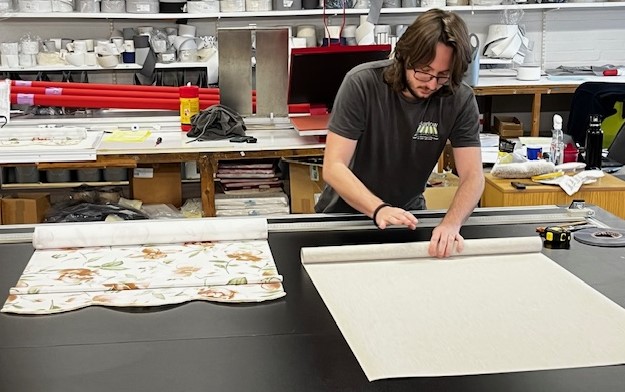
Because we still manufacture roller blinds ourselves in Leicester, we can look at the problem slightly differently.
Instead of automatically asking:
"What new blind should we sell you?"
We can ask:
"What actually needs replacing?"
Sometimes the answer is the whole blind.
Sometimes it isn't.
Seven Blinds Didn't Need Throwing Away
This was the part of the conversation where the customer and I completely agreed.
Why scrap seven perfectly serviceable roller blinds simply because you don't like the fabric?
The tubes have already been manufactured.
So have the brackets and mechanisms.
The blinds have already been transported to the house.
They're already fitted to the windows.
If all of those components are still in good condition and suitable for reuse, why throw them away?
In this case, the obvious thing for us to investigate was whether we could keep the parts that were still doing their job and replace the part that wasn't.
The fabric.
That's potentially better from a waste point of view, and it can also be a more economical option for the customer.
But there's an important caveat here.
Not every roller blind should be recovered.
If a mechanism is worn, components are damaged, the blind isn't suitable or recovering it simply doesn't make sense, we'll say so.
Sometimes a complete replacement really is the better option.
The point is that it shouldn't automatically be the only option.
Sustainability Isn't Always About Buying Something "Eco"
We talk quite a lot about sustainability at Barlow Blinds.
But this morning's visit was a good reminder that sustainability doesn't always mean buying a new product with a special environmental label attached to it.
Sometimes it's much simpler.
Keep the bits that are still perfectly good. Replace the bits that aren't.
It's not particularly glamorous.
It probably won't win any awards.
But it makes sense.
Seven working roller blinds don't necessarily need to become seven new roller blinds just because someone's taste in fabric has changed.
Sometimes they just need to lose the bright yellow flowers.
And I think both the customer and I are going to be quite happy about that.
Can Existing Roller Blinds Be Recovered?
Often, yes.
If you've already got roller blinds that operate properly but the fabric is dated, damaged or simply no longer suits your room, we may be able to replace the fabric while retaining suitable existing components.
Because we manufacture roller blinds ourselves at our Leicester factory, recovering an existing blind is something we can actually consider rather than automatically recommending complete replacement.
But we won't promise it can be done without seeing what you've got.
We'll need to look at the blind, its condition and the components being used.
If everything is suitable, replacing the fabric may be all that's needed.
If it isn't, we'll tell you.
So if you've been told that your only option is to throw away a perfectly good roller blind and buy another one, it may be worth asking us before you do.
Send us a photo of the blind or get in touch and we'll take a look.
Especially if yours has bright yellow flowers.
We've now got some experience with those.
About Phil Coleman
Phil Coleman is the fifth generation of his family to run Barlow Blinds, a Leicester business that has been making blinds since 1887. With over 30 years of hands-on experience, Phil has played a leading role in shaping industry standards including being part of the team that wrote the only NVQ qualification for blind and shutter installers. He also serves on the Management Committee of the British Blind & Shutter Association (BBSA), helping to set best practice across the trade. Under his leadership, Barlow Blinds has remained true to its founding principle: “It’s not our job to find customers for our blinds, it’s our job to find the right blinds for our customers.”
Article Review & Accuracy
Reviewed by: Phil Coleman, Managing Director, Barlow Blinds
Last reviewed: September 2026
Our promise
If new evidence, products or British Standards change our advice, we'll update this article. If we make a mistake, we'll correct it.
This article forms part of the Barlow Blinds Knowledge Centre and is written or personally reviewed by Phil Coleman, drawing on more than 35 years' experience, guidance from the British Blind & Shutter Association (BBSA), British Standards where applicable, manufacturer technical information and real customer feedback.
Major updates to this article are shown at the top or bottom of the page.