Sometimes the Best Blind Is the One You've Already Got
"We've had vertical blinds for 25 years, but we'd quite like a change. What would you recommend?"
That was the question I was asked when I visited a home in Broughton Astley, near Leicester, this week.
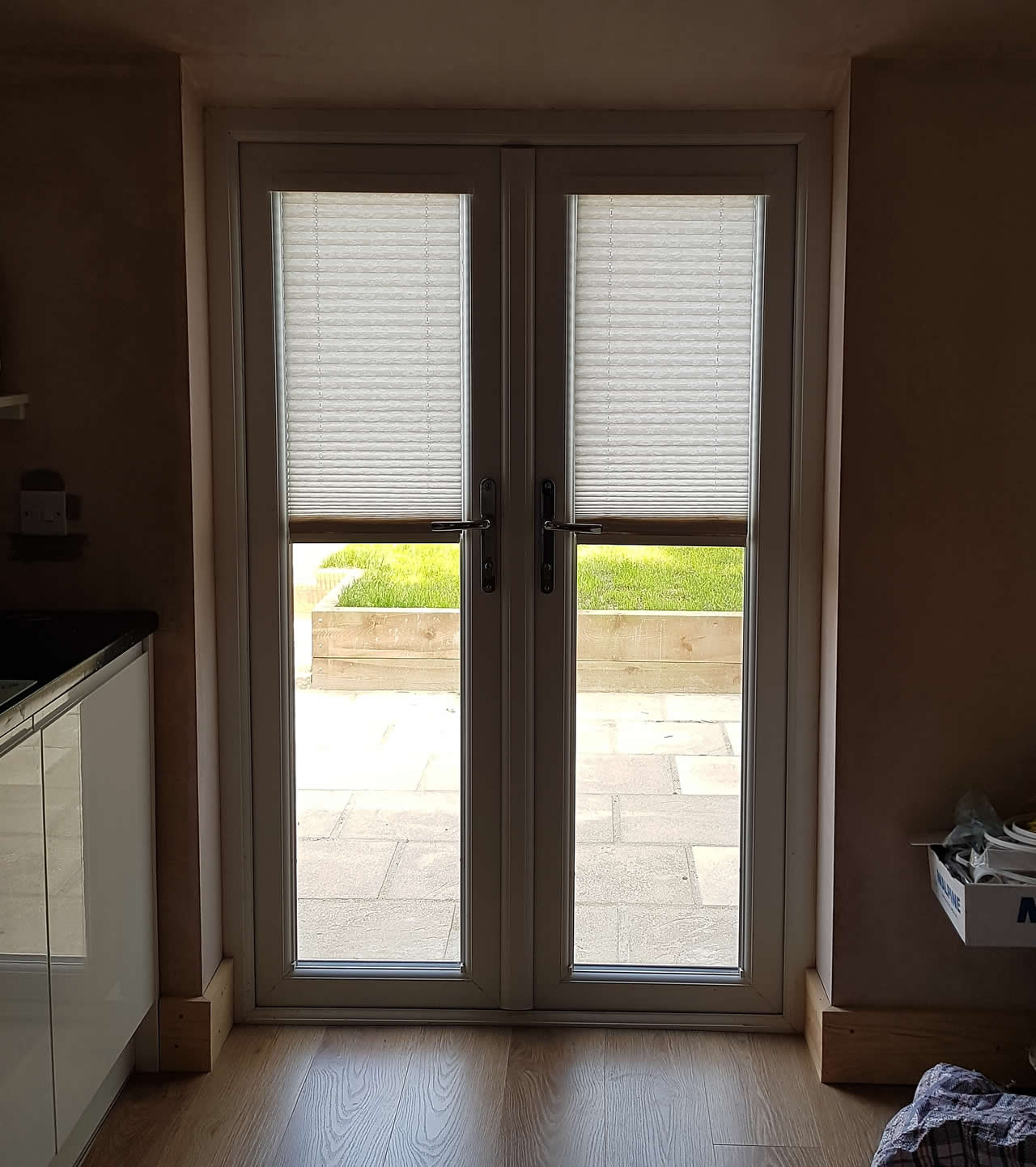
The customer had a pair of French doors with vertical blinds that had been there for around 25 years.
They'd served her well, but after all that time, she fancied something different.
Fair enough. There are certainly more options available today than there were 25 years ago.
But before getting the sample books out, I wanted to ask one question.
"What do you actually need the blinds to do?"
It's Not Always About Privacy
Looking at the French doors, I could see that the property wasn't overlooked.
So privacy wasn't really an issue.
"Mainly controlling the sunlight," she explained. "And making the room feel a bit cosier in the winter."
That gave me something to work with.
There are lots of different blinds that could do both jobs, but that doesn't mean they'd all be equally practical.
And sometimes the things that seem quite minor when you're choosing a blind become rather important when you're using it every day.
I suggested three options.
Option 1: Another Vertical Blind
Probably not what she was expecting me to say!
After all, she'd just told me she wanted a change.
But the most cost-effective solution was another vertical blind.
Vertical blinds are particularly good at controlling sunlight because you can rotate the louvres to adjust how much light enters the room without necessarily closing the blind completely.
They're also easy to operate, which is something we sometimes take for granted.
The main disadvantage at French doors is the stack of louvres that sits at one side when the blind is pulled back.
If you regularly have both doors open, that stack can get in the way.
And that brought us to the second option.
Option 2: A Roller Blind
A roller blind would solve the problem of the louvres stacking at the side.
When it's not needed, the blind rolls neatly away above the doors.
And when the sun starts coming through, you can lower it just enough to provide some shade.
No need to cover the entire window.
But there was a drawback.
Because of the width of the French doors, we'd need a fairly large roller blind.
That means more fabric, a larger roller tube and a blind that would take a bit more effort to raise and lower manually.
She wasn't particularly keen on that idea.
So we moved on.
Option 3: Perfect Fit Cellular Blinds
Now this was an interesting one.
Perfect Fit cellular blinds fit directly onto the individual glazed sections of the doors, becoming part of the door rather than hanging in front of it.
No louvres stacking at the side.
No large roller blind hanging above.
And because the blinds move with the doors, you can open and close them without having to move the blinds out of the way.
They also have another advantage.
Cellular blinds can help reduce heat loss through windows in winter.
The honeycomb-shaped pockets trap air, helping to create an insulating layer at the glass.
And this wasn't something I needed to convince the customer about.
She already had cellular blinds fitted to the bay window in the same room.
In fact, she was the one who brought up how much difference she'd noticed during the winter.
That's always nice to hear, particularly when it's a customer telling you about their own experience rather than me explaining the benefits.
She really liked the idea of having the same style of blind at the French doors.
But there was one problem.
The Problem Nobody Thinks About Until You Mention It
With the Perfect Fit cellular blinds we were discussing, she'd need to reach down towards the bottom of each door to raise them.
Every time.
And while that might not sound like much of an issue, it's worth thinking about how often you operate your blinds.
If you're regularly adjusting them throughout the day to control the sunlight, bending down to operate each blind can become a nuisance.
It's one of those practical details that can easily get overlooked when you're choosing something because you like the way it looks.
She loved the appearance of the cellular blinds.
She liked the fact that they'd match the bay window.
And she already knew how effective cellular blinds could be in winter.
But she wasn't convinced about having to bend down every time she wanted to adjust them.
Which brought us right back to where we'd started.
So, After Looking at Three Options...
We ended up choosing another vertical blind.
Not because it was the cheapest option, although that was a bonus.
And not because there was anything wrong with the alternatives.
It was simply the blind that made the most sense for how she used the room.
She'd had vertical blinds for 25 years.
She knew how they worked.
She liked the way she could control the sunlight.
And she'd never really had a problem with them.
So why change something that's worked perfectly well for a quarter of a century?
The Best Blind Isn't Always the Newest Blind
I've been helping customers choose blinds for more than 35 years, and one thing I've learned is that there's rarely one perfect blind for every situation.
Roller blinds, vertical blinds and cellular blinds all have their advantages.
But they also have disadvantages.
And those disadvantages matter just as much as the benefits.
It's easy to get carried away with a new style, a different fabric or something that looks fantastic in a photograph.
But you're the one who'll be opening and closing those blinds every day.
Not me.
That's why I always think it's worth having a proper conversation about how you actually use a room before deciding what to put at the windows.
Sometimes the best advice I can give a customer is to stick with what they already know works.
And after 25 years, I think these vertical blinds had earned another chance.
At Barlow Blinds, we've been making and fitting blinds in Leicester and Leicestershire since 1887. Whether you're looking for something completely different or simply replacing blinds that have served you well, we'll help you understand the options without any pressure to spend more than you need to.
About Phil Coleman
Phil Coleman is the fifth generation of his family to run Barlow Blinds, a Leicester business that has been making blinds since 1887. With over 30 years of hands-on experience, Phil has played a leading role in shaping industry standards including being part of the team that wrote the only NVQ qualification for blind and shutter installers. He also serves on the Management Committee of the British Blind & Shutter Association (BBSA), helping to set best practice across the trade. Under his leadership, Barlow Blinds has remained true to its founding principle: “It’s not our job to find customers for our blinds, it’s our job to find the right blinds for our customers.”
Article Review & Accuracy
Reviewed by: Phil Coleman, Managing Director, Barlow Blinds
Last reviewed: October 2026
Our promise
If new evidence, products or British Standards change our advice, we'll update this article. If we make a mistake, we'll correct it.
This article forms part of the Barlow Blinds Knowledge Centre and is written or personally reviewed by Phil Coleman, drawing on more than 35 years' experience, guidance from the British Blind & Shutter Association (BBSA), British Standards where applicable, manufacturer technical information and real customer feedback.
Major updates to this article are shown at the top or bottom of the page.