Perfect Fit or Cordless Cellular Blinds? A Real Customer Decision
I was visiting a home in Kibworth this morning where the customers needed blinds for their lounge, kitchen and dining room.
Their biggest problem wasn't privacy.
It was heat.
The rooms are south facing and, when the sun comes out, they can get far too hot.
That immediately influenced the type of blinds we started talking about.
There are plenty of blinds that can give you privacy or control the light, but when reducing heat coming through the glass is one of the main priorities, cellular blinds are one of the options I particularly like.
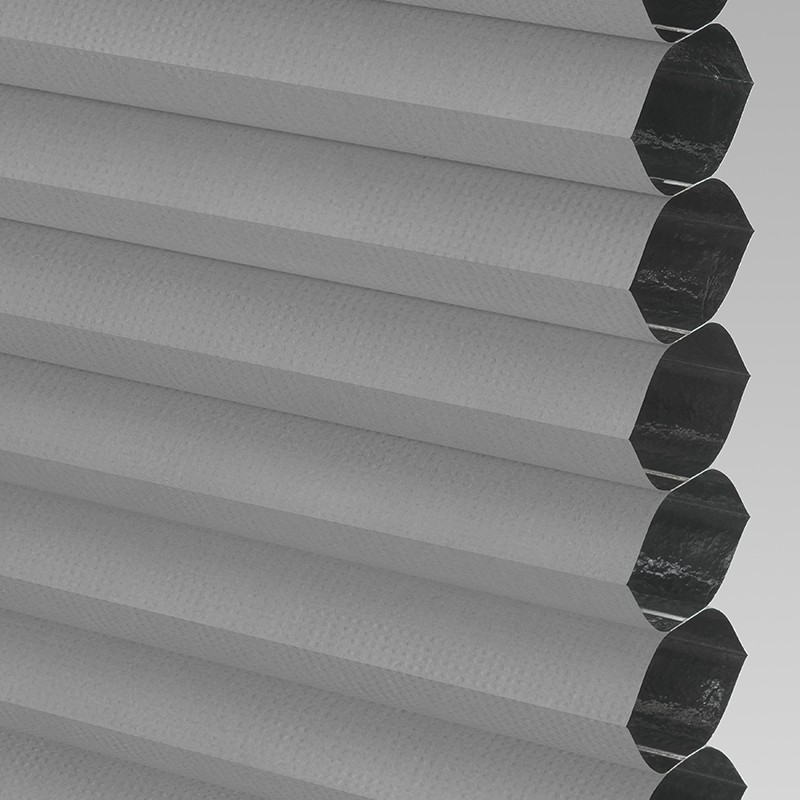
The fabric has a honeycomb construction that creates pockets of air between the room and the glass. That extra layer helps reduce the transfer of heat through the window.
Of course, no internal blind is going to stop a south-facing room getting hot altogether.
But for these customers, cellular blinds gave us a really good combination of heat control, light control and a neat-looking blind that would work across all of the windows and French doors they wanted to cover.
So after a relatively short conversation, we'd agreed on the type of blind.
Cellular blinds.
That bit was easy.
What happened next was much more interesting.
Cordless or Perfect Fit Cellular Blinds?
There were two ways we could install them.
We could use cordless cellular blinds, fitted conventionally across the windows and doors.
Or we could use Perfect Fit cellular blinds, with individual blinds fitted into frames attached directly to each glazed section.
Same cellular fabric.
Same basic reason for having them.
But two very different ways of living with them.
And husband and wife very quickly discovered they were on opposite sides.
At which point, my job became considerably easier.
I mostly stood back and watched.
His Argument: Why Have 18 Blinds When We Can Have 10?
There was quite a lot of glass to cover.
They had:
- A lounge window with three panes
- Three sets of French doors, each with two panes
- A kitchen window with two panes
Using conventional cordless cellular blinds, we could cover everything with 10 blinds.
With Perfect Fit, each individual glazed section needed its own blind.
That meant 18 blinds.
And unsurprisingly, 18 blinds cost more than 10.
In this case, the difference was around £300.
But his argument wasn't only about saving money.
It was about simplicity.
If one cordless blind could cover two or three panes, he could pull down one blind instead of operating two or three separate ones.
Fewer blinds.
Less to operate.
And roughly £300 less.
He had a point.
Her Argument: Perfect Fit Just Looks Better
She wasn't convinced.
For her, Perfect Fit was the clear favourite.
The reason was largely how it looked.
Because each blind sits within its own frame, it feels much more like part of the window or door, rather than a blind hanging in front of it.
And on the French doors in particular, there would be no freely hanging blind when the doors were being used.
Or, as she described it, no blinds:
"Flapping around."
She had a point too.
And this was developing into quite a good debate.
Then he found another advantage.
"But We Can Still Have Shade With the Doors Open"
With Perfect Fit, the blind is attached directly to the glazed section of the French door.
So when you open the door, the blind goes with it.
His argument was that they could leave the blinds down for shade while still having the doors open.
For a moment, I thought that might have swung it.
It hadn't.
She immediately came back with:
"But on the really hot days when we need the blinds to do their job, why would we open the doors and let all the hot air in?"
Fair point.
And at that stage I decided they really didn't need much more from me.
So Which Option Is Better?
This is where blind buying can get frustrating.
Because sometimes there genuinely isn't a best option.
Both types of blind would do what these customers originally wanted them to do: help control the heat coming through their south-facing glazing.
The real decision was about everything else.
Did they value having fewer blinds, less to operate and saving around £300?
Or did they value the more integrated appearance of Perfect Fit and having blinds that moved with the doors?
Neither answer was wrong.
They simply cared about different things.
And there's another part of this that's worth mentioning.
Perfect Fit was the more expensive order for us.
Eighteen blinds rather than ten.
About £300 more.
But that doesn't make Perfect Fit the better choice for their home.
Equally, saving £300 doesn't automatically make the cordless option the sensible choice.
Our job isn't to push the option that produces the bigger order.
It's to make sure the options we're discussing will actually work, explain the advantages and disadvantages of each, and then let the customer decide which compromises they'd rather live with.
In this case, I wasn't entirely sure which way they were going to go.
Cordless Cellular |
Perfect Fit Cellular |
|
Number of blinds |
10 |
18 |
Price |
Around £300 less |
Around £300 more |
Operation |
One blind can cover several panes |
Each pane has its own blind |
Appearance |
Blind hangs in front of the window/door |
Integrated into the window/door |
Doors open |
Blind may need raising |
Blind moves with the door |
Movement |
Can move when doors/windows are open |
Held neatly within its frame |
Best reason to choose it |
Fewer blinds, simpler operation and lower cost |
Neater, more integrated appearance |
So Who Won?
I left them with quotations for both options and came back to the office.
Apparently, while I was out, they rang to say they'd made their decision and wanted to go ahead.
There was just one problem.
My paperwork hadn't made it back to the office yet.
So our team couldn't tell which quotation they were accepting.
They told them we'd call them tomorrow.
Which means, as I write this...
I genuinely still don't know who won.
I'll find out tomorrow.
And I have to admit...
I'm ridiculously curious.
About Phil Coleman
Phil Coleman is the fifth generation of his family to run Barlow Blinds, a Leicester business that has been making blinds since 1887. With over 30 years of hands-on experience, Phil has played a leading role in shaping industry standards including being part of the team that wrote the only NVQ qualification for blind and shutter installers. He also serves on the Management Committee of the British Blind & Shutter Association (BBSA), helping to set best practice across the trade. Under his leadership, Barlow Blinds has remained true to its founding principle: “It’s not our job to find customers for our blinds, it’s our job to find the right blinds for our customers.”
Article Review & Accuracy
Reviewed by: Phil Coleman, Managing Director, Barlow Blinds
Last reviewed: October 2026
Our promise
If new evidence, products or British Standards change our advice, we'll update this article. If we make a mistake, we'll correct it.
This article forms part of the Barlow Blinds Knowledge Centre and is written or personally reviewed by Phil Coleman, drawing on more than 35 years' experience, guidance from the British Blind & Shutter Association (BBSA), British Standards where applicable, manufacturer technical information and real customer feedback.
Major updates to this article are shown at the top or bottom of the page.