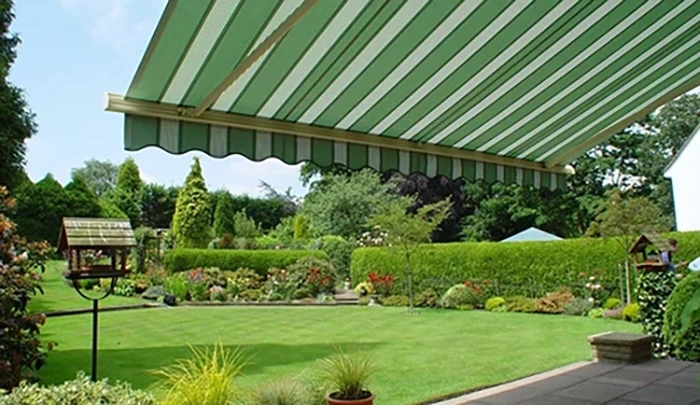
Can You Replace the Fabric on an Existing Patio Awning? Costs, Risks and When It's Worth Doing
"There's nothing wrong with our awning. It still works perfectly. The fabric just looks tired. Surely we don't need to buy a whole new one?"
I've heard variations of that question more times than I can remember.
And it's a fair question.
If you've spent good money on a quality patio awning, why would you want to throw the whole thing away just because the fabric has faded?
The short answer is yes, in many cases you can replace the fabric on an existing patio awning without buying a completely new awning.
But there's something I always tell customers.
Just because you can recover an awning doesn't necessarily mean you should.
I've spent more than 35 years working with blinds and awnings, and I've seen plenty of examples of both.
I've seen 20-year-old awnings that still have years of life left in them.
And I've seen others where spending money on new fabric would be throwing good money after bad.
In this article, I'll explain how we recover patio awnings at Barlow Blinds, what it costs, what can go wrong and, most importantly, how to decide whether recovering your existing awning is actually worth the money.
Because I'd much rather help you make the right decision now than have you regret it six months down the line.
Can You Really Replace Just the Fabric on an Old Patio Awning?
Yes. And sometimes the results are remarkable.
I remember visiting a lady in Leicester who'd spent ages searching online for information about replacing her awning fabric.
She was getting frustrated because everywhere she looked, companies seemed more interested in selling her a new awning.
But she didn't want a new awning.
Her existing one worked perfectly well.
The arms were fine. The mechanism operated smoothly. There was nothing obviously wrong with the framework.
The fabric simply looked old.
And I could understand why she wanted to replace it.
An awning is a fairly prominent feature on the back of your house. When the fabric is faded, stained or looking tired, it can make the whole patio area feel a little neglected.
Fit a fresh cover in a colour you love, and the difference can be enormous.
But before we start talking about colours and patterns, there's something far more important to check.
Is the awning itself worth recovering?
That's where I always start.
Is It Worth Replacing the Fabric on an Old Awning?
When I visit someone who's thinking about recovering their awning, the first thing I'm interested in isn't the fabric.
It's everything underneath it.
I'll look at the arms, the framework, the brackets and the mechanism.
Does the awning open and close smoothly?
Are the arms working correctly?
Is there any obvious damage, corrosion or excessive wear?
And if it's motorised, how old is the motor?
These questions matter because a new cover doesn't make an old mechanism any younger.
You could spend a considerable amount of money on beautiful new fabric, only to discover that another part of the awning needs expensive attention shortly afterwards.
Nobody wants that.
When recovering an awning usually makes sense
I'd generally be happy to consider recovering an awning when:
- The framework is structurally sound.
- The arms and mechanism operate correctly.
- The awning is still the right size for the patio.
- The customer is happy with how it works.
- The main problem is faded, worn or damaged fabric.
- The cost of recovering represents sensible value compared with replacing it.
In those circumstances, a new cover can be an excellent investment.
You're keeping a perfectly serviceable awning in use and improving its appearance without replacing something that still does its job.
When buying a new awning might be better
There are also occasions when I wouldn't recommend recovering.
For example, if the arms are badly worn, the framework is damaged or the mechanism is becoming unreliable, it might not make financial sense.
The same applies if you're already thinking about changing the size of your awning or upgrading its features.
Why spend a substantial amount recovering something that no longer suits your needs?
Sometimes a replacement is the better long-term decision.
And if that's what I think, I'll tell you.
I'd rather lose a recovering job than recommend work that isn't in the customer's best interests.
A quick way to think about it
Your existing awning |
What I'd suggest |
Fabric faded, mechanism working well |
Recovering is worth investigating |
Fabric damaged, framework sound |
A new cover could be a sensible solution |
Motor getting old |
Discuss the motor before recovering |
Arms or mechanism badly worn |
Compare repair and replacement costs |
Awning is too small or doesn't suit your patio |
Consider a new awning |
Unknown or discontinued manufacturer |
Check compatibility and parts availability first |
These aren't hard-and-fast rules.
Every awning needs looking at individually.
But they give you a useful starting point before you spend any money.
Can You Replace Patio Awning Fabric Yourself?
Technically, yes.
Would I recommend doing it yourself?
Absolutely not.
And I'm not saying that simply because we recover awnings for a living.
There's a genuine safety issue that many people don't appreciate.
Patio awning arms are spring-loaded and under considerable tension.
If they're not secured properly when the fabric is removed, they can move suddenly and with tremendous force.
My dad used to tell me about one of our employees who broke his nose while working on an awning many years ago.
He hadn't secured the arms correctly.
The arm moved unexpectedly, and he paid the price.
It's one of those stories that stays with you.
And it's a lesson we've never forgotten.
We now use specialist securing ties and established procedures when working on awnings to reduce the risk of that happening.
But the tension in the arms isn't the only challenge.
Some awnings are surprisingly difficult to handle
I remember recovering a 5-metre-wide awning that needed six people to handle it safely.
Six people.
That's hardly the sort of job you'd want to tackle on a Saturday afternoon with a stepladder and a couple of willing friends.
Then there's the motor, if your awning has one.
The stopping positions may need adjusting when the new fabric is fitted, and some older motors can be particularly awkward to work with.
You also need to make sure the fabric is fitted correctly and operates properly.
Get something wrong, and you could damage the awning or injure yourself.
So while replacing the fabric might sound straightforward, my advice is to leave it to people who understand the mechanisms and have the equipment to work on them safely.
How Do You Replace the Fabric on a Patio Awning?
Different companies approach awning recovering in different ways.
Some carry out the entire job at the customer's home.
At Barlow Blinds, we prefer to remove the awning and take it back to our factory in Leicester, where practical.
There's a reason for that.
We don't just want to put a new piece of fabric on an old frame.
We want to make sure the awning is in the best possible condition when it goes back up.
Here's how our process works.
Step 1: We inspect your existing awning
Before we discuss colours, patterns or prices, we need to establish whether the awning is suitable for recovering.
We'll inspect the framework and mechanism, check how it operates and identify any obvious concerns.
We'll also establish the make and model where possible.
That's important because we can't necessarily obtain parts for every manufacturer, particularly older or discontinued awnings.
If there are limitations, we'll explain them.
And if we think recovering isn't sensible, we'll tell you before you commit to anything.
Step 2: We measure the awning and help you choose a fabric
Once we're happy with the condition of the awning, we'll take the measurements needed to manufacture a replacement cover.
We'll also measure the valance, if your awning has one.
Then you get to choose how you want it to look.
Some customers love their existing stripes and simply want something similar.
Others decide it's time for a complete change.
Perhaps the patio furniture has changed. Maybe the house has been redecorated. Or perhaps they're simply tired of looking at the same colour after 15 years.
Modern awning fabrics come in a wide variety of colours, patterns and finishes.
We'll explain the options available and provide a quotation based on your awning and the fabric you've chosen.
Step 3: Your replacement cover is manufactured
Once you've chosen the fabric and placed your order, the new cover is manufactured to fit your existing awning.
Lead times vary depending on the supplier and the time of year.
One advantage of recovering is that your awning can normally remain in place while the new fabric is being made.
So you're not necessarily without shade for the whole manufacturing period.
Step 4: We remove the awning and take it to our factory
When the replacement cover is ready, we'll arrange to remove the existing awning, where practical, and take it back to our Leicester factory.
I particularly like this approach because it gives us the opportunity to do more than simply change the fabric.
We can clean the framework properly.
We can inspect the mechanism more closely.
And we can lubricate suitable components where appropriate.
After all, there's not much point fitting a lovely new cover to a frame that's covered in years of accumulated dirt.
I find there's something quite satisfying about seeing an older awning cleaned up and fitted with fresh fabric.
It's still the customer's original awning.
But it can look dramatically different.
Step 5: We refit your awning
Once the work is complete, we'll return and reinstall the awning.
We'll check its operation and make sure everything is working as it should.
The awning will normally be away for around a week, although this can vary depending on the work involved.
And that's it.
You've kept your existing awning, but given it a new appearance and a fresh lease of life.
How Much Does It Cost to Replace Patio Awning Fabric?
Now we're getting to the question most people really want answered.
What's it going to cost?
And I think it's a question companies should be prepared to discuss openly.
There's little point telling someone how wonderful recovering can be if they have absolutely no idea whether they're looking at a few hundred pounds or well over a thousand.
The price depends mainly on three things:
- The width of the awning. Wider awnings generally require more fabric and can be more difficult to handle.
- How far the awning projects. A greater projection means a larger cover.
- The fabric you choose. Different fabrics and specifications can affect the price.
The condition, design and accessibility of the awning may also affect the work required.
Example patio awning recovering prices
To give you an idea of the sort of figures involved, here are prices from our original awning recovering guide.
Awning width |
Projection |
guide price |
3 metres |
2 metres |
£1010 |
3 metres |
2.5 metres |
£1050 |
3.5 metres |
2 metres |
£1030 |
3.5 metres |
2.5 metres |
£1070 |
3.5 metres |
3 metres |
£1,110 |
4 metres |
2 metres |
£1150 |
4 metres |
2.5 metres |
£1190 |
4 metres |
3 metres |
£1,230 |
4.5 metres |
2 metres |
£1,270 |
4.5 metres |
2.5 metres |
£1,310 |
4.5 metres |
3 metres |
£1,350 |
5 metres |
2 metres |
£1,690 |
5 metres |
2.5 metres |
£1,730 |
5 metres |
3 metres |
£1,770 |
These examples cover many of the sizes we're asked about in Leicester and Leicestershire.
We can also consider larger awnings, depending on their make, design and condition.
But there's something worth remembering.
A recovering quotation isn't simply a price for a piece of fabric.
There's measuring, manufacturing, handling and fitting involved.
In our case, there may also be removal, transport, factory work and reinstallation.
Before accepting any quotation, make sure you understand exactly what's included.
For example, ask whether the price covers removing and refitting the awning, whether any necessary motor adjustments are included and what happens if additional problems are discovered.
Those are sensible questions, and a reputable company should be happy to answer them.
Is recovering cheaper than buying a new awning?
It can be.
But I wouldn't automatically assume that recovering is always the cheaper or better-value option.
The real question is how much useful life you expect to get from the existing awning once the new cover has been fitted.
If the mechanism is in excellent condition, recovering may be a very sensible investment.
But if several expensive components are approaching the end of their life, it may be worth putting that money towards a new awning instead.
That's why I believe the condition of the existing awning matters just as much as the recovering price.
If Your Awning Is Motorised, There's Another Cost You Should Think About
This is something I've become particularly conscious of over the years.
How old is your awning motor?
And I can tell you exactly why I ask.
A few years ago, we recovered a customer's motorised awning.
The work went well.
The new fabric looked great.
The motor was working perfectly when we finished.
Six months later, it failed.
Naturally, the customer was disappointed.
They'd recently spent money having the awning recovered, and now they were facing another expense.
We hadn't done anything wrong. There was no obvious indication that the motor was about to fail.
But it bothered me.
Because looking back, I wished we'd had a more detailed conversation about the age of the motor before doing the work.
Not because I would necessarily have recommended replacing it.
But because the customer deserved to understand the risk and the options.
That experience changed how I approach older motorised awnings.
Why replacing the motor during a recover can make sense
If your motorised awning is 15 or 20 years old, it's worth discussing whether the motor should be replaced while the awning is already being worked on.
Why?
Because replacing a motor as part of a recovering job can be considerably less expensive than arranging a separate visit later.
Motor replacement |
Historical example cost |
During an awning recover |
£799 |
As a separate job |
£1,299 |
Difference |
£500 |
They illustrate the point.
If the awning is already being removed and worked on, some of the labour involved in replacing the motor may already be accounted for.
That can make a significant difference.
Now, does that mean you should automatically replace a motor that's working perfectly well?
No.
Absolutely not.
You might decide to keep it and take the chance.
And that's a perfectly reasonable decision.
But at least you'll know what the options are and what the potential future costs could be.
That's what matters.
Can You Recover an Awning That Wasn't Originally Supplied by Barlow Blinds?
Yes, sometimes we can.
But there are limitations, and I think it's important to explain them.
We recently visited a gentleman in Market Bosworth who had a 17-year-old Hillarys awning.
He'd looked after it.
The mechanism was still working, and the framework was in reasonable condition.
But the fabric was showing its age.
He wanted to know whether we could replace the cover.
The good news was that we could.
However, I also explained that because it wasn't one of our own awnings, we couldn't necessarily obtain every replacement component.
In that particular case, we could deal with the fabric and potentially the motor.
But we couldn't promise to replace every part of the original mechanism if something went wrong in the future.
And that's an important distinction.
Being able to recover an awning isn't the same as being able to repair every part of it.
Different manufacturers use different components, and older models can be particularly difficult when it comes to obtaining spares.
So if you've got an awning from another company, don't assume recovering is impossible.
It's certainly worth asking.
But make sure the company doing the work understands what they're dealing with and explains any limitations before you proceed.
Will New Fabric Make My Old Awning Look Like New?
It can make a tremendous difference.
But I'd be careful about promising that it will look exactly like a brand-new awning.
A fresh cover can completely transform the appearance of a patio.
I've seen awnings where the fabric was so faded that you'd almost forgotten what the original colour looked like.
Put a new cover on, and suddenly the whole patio looks brighter.
But the framework is still the original framework.
If it's 20 years old, it's still 20 years old.
Cleaning it can make a big difference, but it won't remove every mark or reverse every sign of ageing.
And fitting new fabric won't fix worn arms or a failing mechanism.
I think it's better to be realistic about that.
If you expect a recovered awning to look exactly like a completely new installation, you could be disappointed.
But if your aim is to refresh the appearance of a sound, working awning, the result can be extremely satisfying.
Is Recovering an Awning Better for the Environment?
There's another benefit to recovering that doesn't always get much attention.
You're keeping something useful in service rather than replacing the entire product.
If the framework and mechanism are still in good condition, replacing the fabric means you don't have to discard those components simply because the cover has faded.
And that makes sense to me.
We've become so used to replacing things when they start looking old that sometimes we forget they can still have plenty of useful life left.
Of course, recovering still involves manufacturing new fabric, transport and labour.
So I wouldn't pretend there's no environmental impact.
But keeping a sound awning in use rather than replacing the whole thing can avoid unnecessary waste.
And when recovering makes practical and financial sense, that's another good reason to consider it.
Five Questions I'd Ask Before Paying to Recover an Awning
If you're considering recovering your patio awning, these are the questions I'd want answered before spending any money.
1. Is the framework genuinely in good condition?
Don't judge it purely by how it looks.
Make sure the arms, brackets and mechanism have been checked.
2. How old is the motor?
If it's motorised, find out whether replacing the motor during the recovering work would be worth considering.
3. Can replacement parts still be obtained?
This is particularly important with older awnings and models supplied by other manufacturers.
4. What's included in the quotation?
Ask about fabric, removal, fitting, transport, any necessary adjustments and potential additional charges.
5. How does the recovering cost compare with a new awning?
Don't just compare the prices.
Think about the condition of the existing awning, how long you expect it to last and whether it still meets your needs.
If you get clear answers to those five questions, you'll be in a much better position to decide what to do.
Frequently Asked Questions About Replacing Patio Awning Fabric
Can you replace awning fabric without replacing the frame?
Yes. If the existing frame and mechanism are in suitable condition, it's often possible to replace the fabric while keeping the original framework.
How long does it take to recover a patio awning?
At Barlow Blinds, your existing awning can normally remain in place while the replacement cover is manufactured.
Once we remove the awning for recovering, it's usually away for around a week, depending on the work involved.
Can you recover a motorised patio awning?
Yes, provided the awning is suitable for recovering. However, older motors may need additional attention, and their condition should be discussed before the work begins.
Can you recover an awning made by another manufacturer?
Sometimes. It depends on the make, model, condition and compatibility of the awning. Availability of replacement parts may also be limited.
Is it worth recovering a 20-year-old awning?
It can be, if the framework and mechanism are still in good condition.
Age alone doesn't necessarily mean an awning needs replacing.
But the older it is, the more important it becomes to inspect the mechanical components and consider potential future repair costs.
Can I buy replacement awning fabric and fit it myself?
Replacement fabric may be available, but fitting it can be dangerous because awning arms are under considerable spring tension.
I'd strongly recommend using an experienced professional rather than attempting the job yourself.
Before You Buy a New Awning, Let Someone Look at Your Old One
One thing I've learnt after more than 35 years in this business is that customers don't always need something new.
Sometimes they just need someone to look at what they've already got and explain the options.
I've seen older awnings that were well worth recovering.
And I've seen others where spending money on new fabric simply wouldn't have made sense.
The trick is knowing the difference.
If you've got an awning in Leicester or Leicestershire that's looking tired, but still seems to be working properly, don't automatically assume you need a new one.
It might have plenty of useful life left.
And a replacement cover could be all it needs.
At Barlow Blinds, we'll inspect your existing awning, explain what can and can't be done, and give you a straightforward quotation.
If recovering is a sensible option, we'll explain what's involved.
And if we think you'd be better off putting that money towards a new awning, we'll tell you that too.
Because the last thing I want is for someone to spend a thousand pounds or more on an awning that isn't going to give them years of use.
Got an older patio awning in Leicester or Leicestershire? Get in touch with Barlow Blinds and let's see whether it's worth giving it another lease of life.
No pressure to buy a new awning when the old one is still doing its job.
Sometimes the best investment is making the most of what you've already got.
About Phil Coleman
Phil Coleman is the fifth generation of his family to run Barlow Blinds, a Leicester business that has been making blinds since 1887. With over 30 years of hands-on experience, Phil has played a leading role in shaping industry standards including being part of the team that wrote the only NVQ qualification for blind and shutter installers. He also serves on the Management Committee of the British Blind & Shutter Association (BBSA), helping to set best practice across the trade. Under his leadership, Barlow Blinds has remained true to its founding principle: “It’s not our job to find customers for our blinds, it’s our job to find the right blinds for our customers.”
Article Review & Accuracy
Reviewed by: Phil Coleman, Managing Director, Barlow Blinds
Last reviewed: October 2026
Our promise
If new evidence, products or British Standards change our advice, we'll update this article. If we make a mistake, we'll correct it.
This article forms part of the Barlow Blinds Knowledge Centre and is written or personally reviewed by Phil Coleman, drawing on more than 35 years' experience, guidance from the British Blind & Shutter Association (BBSA), British Standards where applicable, manufacturer technical information and real customer feedback.
Major updates to this article are shown at the top or bottom of the page.