My Wife Has Been Opening and Closing Our Neighbours' Curtains Twice a Day. There's an Easier Way.
It's National Home Security Month this October, and something that's been happening in our street recently has got me thinking about a benefit of modern blinds that people don't always consider.
For more information about National Home Security Month click here
My wife has been looking after our neighbours' house while they're away.
Every evening, she's been popping round to close their curtains and switch a lamp on.
Then, every morning, she's been going back to open the curtains and turn the lamp off.
Twice a day. Every day.
All to make the house look as though somebody is home.
It's something many of us have done for friends, family and neighbours over the years. And it's a perfectly sensible thing to do.
But when she told me what she'd been doing, I couldn't help thinking there was a much easier way.
After all, I do run a blind company!
And one of the things we've learnt over more than 35 years in the blind industry is that blinds can do quite a bit more than simply keep the sun out.
So, with National Home Security Month upon us, I thought it would be worth looking at how blinds and shutters can help with home privacy, what motorised blinds can do while you're away, and a few things homeowners might not have considered.
Because sometimes it's the less obvious benefits that turn out to be the most useful.
Could Motorised Blinds Save My Wife Two Trips a Day?
Quite possibly!
When people first ask us about motorised blinds, it's usually because they want a bit more convenience.
Perhaps they've got large bifold doors, windows that are difficult to reach, or several blinds they'd like to operate together without walking around the room.
All perfectly good reasons.
But something that often surprises people is that certain motorised blind systems can also be programmed to open and close automatically.
With the right motor and compatible smart home controls, you could have your blinds:
- Open in the morning to let the daylight in.
- Close in the evening when it starts getting dark.
- Operate at different times rather than following exactly the same routine every day.
- Open or close remotely using your phone while you're away.
Add a suitable smart plug to a table lamp, and you've recreated much of what my wife has been doing for our neighbours.
Only without someone having to pop round twice a day.
Now, there's an important distinction here.
Not all motorised blinds are smart blinds.
Some motorised blinds simply operate using a remote control. They're convenient, but they won't necessarily open and close on a schedule.
Others can work with timers, hubs or compatible smart home systems, giving you considerably more control.
And some features depend on having the correct motor, additional equipment or a reliable internet connection.
It's worth understanding these differences before buying, rather than assuming every motorised blind will do everything.
There's also something else I should make clear.
Automated blinds aren't a security system, and they certainly can't guarantee that your home won't be burgled.
What they can do is help create the appearance of normal activity while you're away.
And that's a useful additional benefit, particularly when combined with sensible home security measures.
Home Security Isn't Just About Locks and Alarms
When we think about keeping our homes secure, most of us immediately think about locks, burglar alarms, security cameras and outside lighting.
And rightly so.
But there's another question worth asking.
How much of your home can somebody see just by walking past?
Think about your own house for a moment.
If somebody walked past your front window this evening, could they see your television?
Perhaps a laptop on the dining room table?
Your home office equipment?
Or even just the layout of your lounge and the things you've got inside it?
It's something that's surprisingly easy to overlook when you're sitting comfortably in your own home.
Particularly in the evening, when you've got the lights on.
Now, I'm not suggesting that blinds will stop somebody breaking into a house. They won't.
But they can help prevent people from seeing what's inside in the first place.
And for many homeowners, that privacy is one of the biggest reasons for having blinds or shutters fitted.
You Shouldn't Have to Choose Between Privacy and Daylight
One thing we've noticed over the years is how often people assume that having privacy means keeping their blinds completely closed.
It doesn't have to.
When we're visiting customers, one of the concerns we regularly hear is that they don't want people looking into their lounge, but they don't want to lose all their natural light either.
And I completely understand.
If you've got a lovely bright room, the last thing you want is to sit in the dark all day simply because people walk past your window.
This is where choosing the right type of blind can make a real difference.
Venetian blinds are a good example. By tilting the slats, you can restrict the view into your home while still allowing daylight through.
Vertical blinds work in a similar way. You can rotate the louvres to control both the light entering the room and how much somebody outside can see.
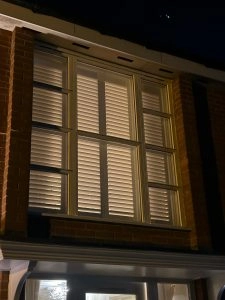
Interior shutters also have adjustable louvres and can be particularly useful for street-facing windows where privacy is important throughout the day.
Day and Night blinds use alternating sections of fabric that can be adjusted to give you different levels of light and privacy.
Each has its advantages, and the best option will depend on your windows, the room and what you're trying to achieve.
But there's something I always encourage people to think about.
What works for privacy at two o'clock in the afternoon might not work nearly as well at eight o'clock in the evening.
And that's where people can sometimes get caught out.
What Happens to Your Privacy When You Turn the Lights On?
This is something we regularly discuss with customers because it's not always obvious when you're choosing blinds.
During the day, certain light-filtering fabrics can give you a good level of privacy.
That's partly because it's generally brighter outside than it is inside.
But when the sun goes down and you switch your lights on, those lighting conditions are reversed.
And suddenly, a fabric that seemed perfectly private during the afternoon might allow people outside to see shapes or silhouettes.
You may have experienced something similar yourself.
Walk past a house in the evening with the lights on and, depending on the window coverings, you can sometimes make out far more than the people inside probably realise.
That's why we always encourage customers to think about how they use a room, not simply how a blind looks in a showroom or during the daytime.
If nighttime privacy is particularly important, the fabric and design of the blind both matter.
Blackout fabrics can provide excellent privacy through the material itself, although some blind systems will still have gaps around the edges.
And adjustable blinds and shutters need to be positioned appropriately to restrict the view inside.
The important thing is to choose a blind that provides the privacy you need when you actually need it.
Not just when the sun is shining.
Should You Leave Your Blinds Closed When You Go on Holiday?
This is an interesting one.
Imagine you're going away for a fortnight.
Before leaving, you check the doors, lock the windows, set the alarm and close every blind in the house.
Job done.
And from a privacy point of view, you've certainly made it harder for people to see inside.
But here's something else to consider.
What does your house look like from the street if every blind stays in exactly the same position for the next two weeks?
Could that make it look as though nobody is home?
Possibly.
Of course, every property is different, and there isn't one approach that's right for every house.
Some people keep certain blinds closed all the time anyway.
But in a home where the blinds normally open in the morning and close in the evening, maintaining that routine while you're away may help the property appear occupied.
And this brings us back to my wife and our neighbours.
She's been doing exactly that, manually, twice a day.
With a compatible smart motorised blind system, some of that routine could be automated.
You could arrange for blinds to open in the morning and close later in the day, and certain systems allow you to vary those times.
That doesn't mean somebody shouldn't keep an eye on the property.
Having a trusted neighbour check the house, collect post or deal with anything unexpected is still valuable.
But it might save them having to visit quite so often.
Something I'm sure my wife would appreciate!
Are Motorised Blinds Expensive? And Are They Worth It?
It's a fair question.
And one I'd encourage anybody considering motorisation to ask before making a decision.
Motorised blinds generally cost more than equivalent manually operated blinds because you're paying for the motor and controls as well as the blind itself.
If you want smart home integration, timers or app-based control, there may also be additional equipment or setup costs.
The exact price depends on several things, including the type and size of blind, the motor system and the features you want.
Some motors are rechargeable or battery-powered, while others require a mains power supply.
And not every existing blind can simply have a motor added to it.
That's why it's worth talking through your requirements before deciding which system to buy.
But here's the question I'd ask.
What do you actually want motorisation to do for you?
If you simply want to operate a blind without getting up from your chair, a straightforward remote-controlled system might be all you need.
If you've got several blinds across large bifold doors, being able to operate them together could be particularly convenient.
And if you regularly travel or spend time away from home, scheduling and remote operation might be worth considering.
On the other hand, if you've got one small, easily accessible window and you're perfectly happy opening the blind yourself, paying extra for motorisation might not make much sense.
And that's fine too.
After all, there's no point spending money on features you'll never use.
Are Shutters Better Than Blinds for Home Security?
This is another question worth looking at, particularly during National Home Security Month.
Interior shutters are often seen as a substantial window covering.
They have a solid frame, adjustable louvres and a more permanent appearance than many types of fabric blind.
And they can be excellent for privacy.
But I'd be very careful about describing ordinary interior shutters as a security product.
Interior shutters and purpose-designed security shutters are two very different things.
The shutters we fit inside people's homes are primarily designed to provide privacy, light control and an attractive finish to the window.
They're not intended to physically prevent somebody from entering the property.
So, if you're considering shutters specifically because you're worried about home security, it's important to understand what they can and cannot do.
And here's something else worth remembering.
You don't necessarily need shutters to achieve good privacy.
Depending on the room and window, a Venetian blind or vertical blind might do exactly what you need at a lower cost.
We've always believed in recommending the product that's right for the customer rather than automatically suggesting the most expensive option.
And sometimes the simpler solution is the better one.
Five Things I'd Check Around My Own Home
If you're thinking about improving privacy around your home, there are a few simple things worth doing before spending any money.
1. Have a look through your windows from outside
This sounds obvious, but when was the last time you actually did it?
With permission from anyone inside, stand outside your home and see what you can make out through the windows.
You might be surprised.
Particularly if you've got valuable items near a window or a room that faces directly onto the street.
2. Check what happens when the lights are on
Don't just look during the day.
Try the same thing in the evening.
Some blinds and fabrics behave very differently when it's darker outside than inside.
It's better to discover that yourself than assume you've got more privacy than you actually have.
3. Think about adjustable blinds
If your main concern is people looking in during the day, you might not need to block out all the light.
Venetian blinds, vertical blinds and shutters can allow you to adjust the view into your home while still enjoying natural daylight.
4. Consider automation if you're regularly away
If you spend a lot of time travelling, compatible motorised blinds might be worth investigating.
But make sure you understand exactly what the system can do.
Remote-controlled, timed and smart-connected systems aren't necessarily the same thing.
5. Don't forget the basics
Blinds are only one small part of home security.
Good locks, suitable lighting, alarms where appropriate and keeping valuables out of obvious view are all important considerations.
And if you're going away, having somebody you trust keep an eye on the property can still be very useful.
Even if you do have motorised blinds.
Sometimes It's the Benefits You Don't Think About
After more than 35 years working in the blind industry, one thing I've learnt is that people often buy a particular type of blind for one reason and then discover other benefits once they start using it.
Motorised blinds are a good example.
Most people initially think about the convenience.
Not having to reach over furniture.
Being able to operate blinds on difficult-to-reach windows.
Or simply opening and closing several blinds at the touch of a button.
But the ability to schedule compatible blinds to operate while you're away is another benefit that doesn't always get mentioned.
And it's certainly one worth considering.
Of course, not everybody needs motorised blinds.
And if privacy is your main concern, a well-chosen manual blind or shutter might be all that's required.
The important thing is understanding what you want your window coverings to do before deciding which product is right for you.
If you're thinking about new blinds or shutters, we're always happy to talk through the options, including the advantages, limitations and whether paying extra for motorisation is really worthwhile.
As for our neighbours?
I'm sure they're very grateful that my wife has been looking after their house.
About Phil Coleman
Phil Coleman is the fifth generation of his family to run Barlow Blinds, a Leicester business that has been making blinds since 1887. With over 30 years of hands-on experience, Phil has played a leading role in shaping industry standards including being part of the team that wrote the only NVQ qualification for blind and shutter installers. He also serves on the Management Committee of the British Blind & Shutter Association (BBSA), helping to set best practice across the trade. Under his leadership, Barlow Blinds has remained true to its founding principle: “It’s not our job to find customers for our blinds, it’s our job to find the right blinds for our customers.”
Article Review & Accuracy
Reviewed by: Phil Coleman, Managing Director, Barlow Blinds
Last reviewed: October 2026
Our promise
If new evidence, products or British Standards change our advice, we'll update this article. If we make a mistake, we'll correct it.
This article forms part of the Barlow Blinds Knowledge Centre and is written or personally reviewed by Phil Coleman, drawing on more than 35 years' experience, guidance from the British Blind & Shutter Association (BBSA), British Standards where applicable, manufacturer technical information and real customer feedback.
Major updates to this article are shown at the top or bottom of the page.