What Are the Best Blinds for a Dental Surgery? It's Not Just About the Fabric
I visited a dental clinic in Leicestershire last week that wanted blinds for its treatment rooms.
The enquiry was connected to a visit from the Care Quality Commission (CQC).
I'm not entirely sure whether the inspectors had already visited or whether the clinic was preparing for an inspection.
But one thing did surprise me.
None of the treatment rooms had any window coverings.
Now, when most people think about blinds, they're probably thinking about privacy, controlling sunlight or making a room look a little nicer.
And those things are just as important in a dental surgery.
But there's something else to consider.
Hygiene.
And as our conversation developed, it became clear that choosing the right blinds for a dental treatment room involves rather more than choosing a colour.
What Does the CQC Look for When It Comes to Window Blinds?
The CQC doesn't specify that dental surgeries must have a particular type of blind.
However, it does expect healthcare providers to consider things such as patient privacy, infection prevention, cleanliness and the suitability of their premises.
I did a little research after my visit and discovered that the CQC has previously highlighted missing window coverings in consultation rooms as a concern about patient privacy.
So something as simple as a window blind can be relevant to an inspection.
But privacy is only part of the story.
In a treatment room, anything you install needs to be suitable for an environment where cleaning and infection prevention are taken seriously.
And that includes the blinds.
Not All Blind Fabrics Are the Same
The first thing we discussed was the fabric.
For a normal living room, you might choose a roller blind because you like the colour or the way the fabric looks.
In a dental surgery, I think we need to start with a different question.
How easy is it going to be to keep this blind clean?
I showed the clinic a specialist fabric called Ex-Lite, manufactured by Louvolite, and left them with a swatch to consider.
Ex-Lite is a PVC-based fabric designed for environments where moisture resistance and cleaning are important.
It has several useful properties:
- It's wipe-clean.
- It's moisture-resistant.
- It has antimicrobial properties and documented resistance to bacteria and fungi.
- It's a blackout fabric, providing privacy through the material.
- It meets a recognised flame-retardancy standard.
That doesn't mean the blind never needs cleaning, and it certainly doesn't mean that fitting it automatically makes a dental surgery CQC compliant.
But it does make it a sensible fabric to consider for a treatment room.
And it comes in 13 colours, so choosing something practical doesn't necessarily mean sacrificing appearance.
But What About the Chain?
This was probably the most interesting part of our conversation.
Most roller blinds are operated using a chain.
It's a simple, reliable and relatively inexpensive system.
And for most homes, it works perfectly well.
But in a dental treatment room, that chain is another component that needs to be cleaned.
So we started discussing alternatives.
Option 1: A Gearbox with a Removable Handle
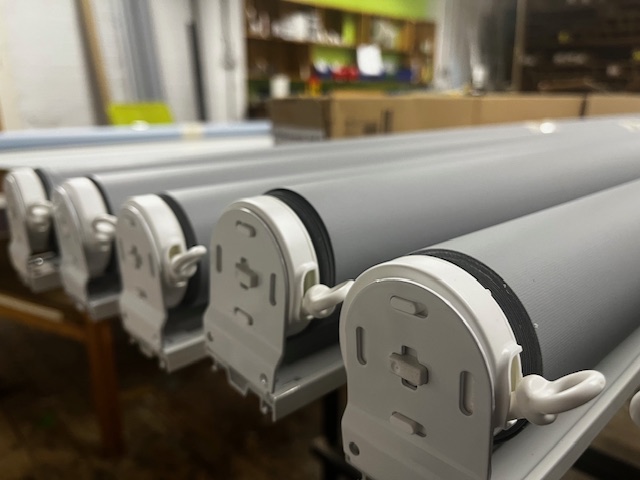
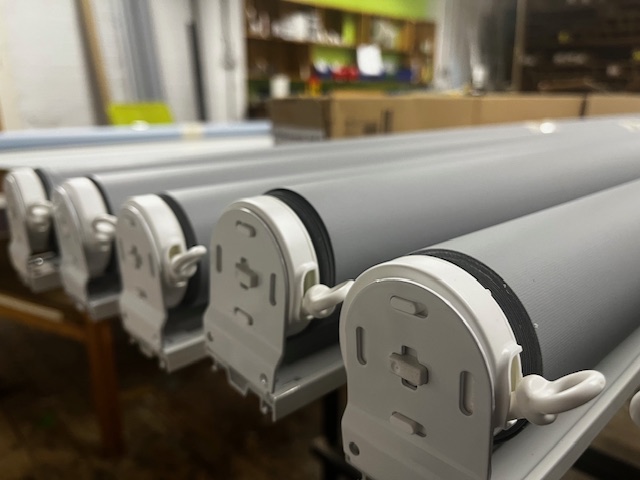
One possibility was to use a gearbox-operated roller blind.
Instead of a conventional hanging chain, the blind is operated using a removable handle.
The advantage is that the handle can be taken away for cleaning and stored when it's not being used.
It's still a manually operated blind, but it removes the conventional chain from the equation.
In my opinion it also looks neater as there is no chain hanging there all of the time.
Option 2: Motorised Roller Blinds
The next option was motorisation.
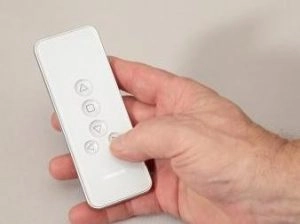
With a motorised roller blind, there's no chain or operating handle.
You simply press a button on a remote control to raise or lower the blind.
That certainly makes operating the blind easier.
But then we discussed something else.
The remote control would still need cleaning.
Which led us to a third possibility.
Option 3: What If Nobody Needed to Touch the Blind?
By connecting compatible motorised blinds to a hub, we could programme them to open and close automatically at set times.
For example, the blinds could raise in the morning and lower towards the end of the day.
Staff could still adjust them when necessary, but the routine daily operation wouldn't involve touching a chain, handle or remote control.
Would this completely remove the need for cleaning?
Of course not.
The blinds themselves would still need cleaning, and any controls used occasionally would need to be included in the practice's cleaning arrangements.
But it could reduce the number of times staff need to touch the operating equipment.
And in a clinical environment, that's worth considering.
Is Motorisation Worth the Extra Cost?
Not necessarily for every dental surgery.
A manually operated blind with a suitable wipe-clean fabric may be perfectly adequate.
And if the blinds are rarely adjusted, there may be very little advantage in paying extra for motorisation.
But if the blinds are being raised and lowered several times a day, or the practice wants to reduce routine contact with operating controls, motorisation becomes a more interesting option.
The important thing is understanding how the room is used before deciding which system to recommend.
So What Did the Dental Clinic Choose?
At the time of writing, no final decision has been made.
I left the clinic with an Ex-Lite fabric swatch and several operating options to consider.
And I'm perfectly happy with that.
My job isn't to sell someone the most expensive blind I can.
It's to explain the options, including their advantages and disadvantages, so they can make the right decision for their premises.
Sometimes the simplest solution is the best.
Other times, spending a little more can make a genuine difference to how a blind works and how easy it is to maintain.
Choosing Blinds for Healthcare Premises
We've been manufacturing blinds in Leicester since 1887, and over the years we've supplied blinds for all sorts of different environments.
One thing I've learned is that a blind which works perfectly well in someone's living room isn't necessarily the best choice for a school, office or dental treatment room.
The surroundings matter.
How the blind is used matters.
And sometimes the smallest details, such as how you raise and lower it, can be just as important as the fabric itself.
If you're looking for blinds for a dental surgery, GP practice or other healthcare premises in Leicester or Leicestershire, we're always happy to discuss the options.
Because choosing the right blind should start with understanding what you need it to do.
About Phil Coleman
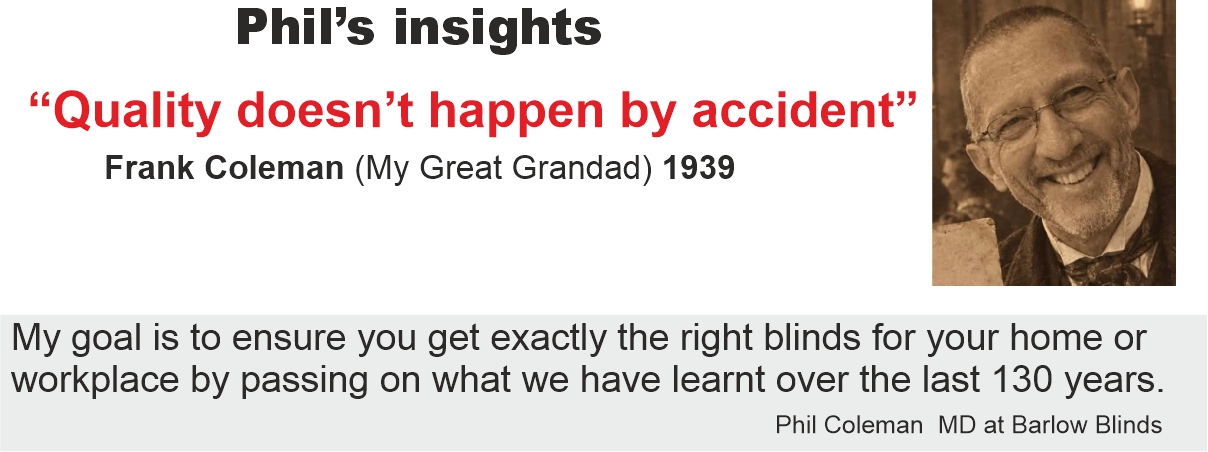
Phil Coleman is the fifth generation of his family to run Barlow Blinds, a Leicester business that has been making blinds since 1887. With over 30 years of hands-on experience, Phil has played a leading role in shaping industry standards including being part of the team that wrote the only NVQ qualification for blind and shutter installers. He also serves on the Management Committee of the British Blind & Shutter Association (BBSA), helping to set best practice across the trade. Under his leadership, Barlow Blinds has remained true to its founding principle: “It’s not our job to find customers for our blinds, it’s our job to find the right blinds for our customers.”
Article Review & Accuracy
Reviewed by: Phil Coleman, Managing Director, Barlow Blinds
Last reviewed: November 2026
Our promise
If new evidence, products or British Standards change our advice, we'll update this article. If we make a mistake, we'll correct it.
This article forms part of the Barlow Blinds Knowledge Centre and is written or personally reviewed by Phil Coleman, drawing on more than 35 years' experience, guidance from the British Blind & Shutter Association (BBSA), British Standards where applicable, manufacturer technical information and real customer feedback.
Major updates to this article are shown at the top or bottom of the page.