Just Because a Blind Has Been Professionally Fitted Doesn't Mean It's Been Fitted Properly
I visited a home in Loughborough this week where the customers wanted to replace an existing roller blind.
The blind was only three years old, and the first question they asked was one I always like hearing.
"Can we reuse the existing roller and brackets and just change the fabric?"
Absolutely. Well, normally.
We manufacture our own roller blinds here in Leicester, and replacing the fabric rather than throwing away perfectly good components is something we're always happy to do.
It's more sustainable, it saves the customer money, and if the existing mechanism is working perfectly well, why replace it?
"Let me have a quick look. Normally that's not a problem."
But when I looked at how their existing blind had been installed, I couldn't quite believe what I was seeing.
"Did You Fit This Blind Yourself?"
That was my first question.
And I had to be a little careful how I asked it.
Because if the customer had fitted the blind themselves, I could understand some of the things I was looking at.
We're not all professional blind fitters, and installing a roller blind might appear to be a relatively straightforward DIY job.
"No, we had it professionally fitted by --------."
I'm deliberately leaving the company's name out.
This isn't about naming and shaming another business.
But I genuinely couldn't believe that someone had been paid to install a blind like this.
And the more I looked, the more problems I found.
What Was Wrong With the Roller Blind Installation?
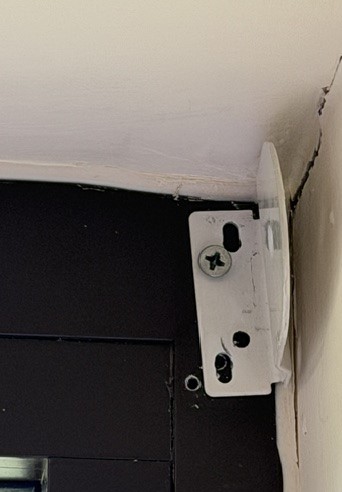
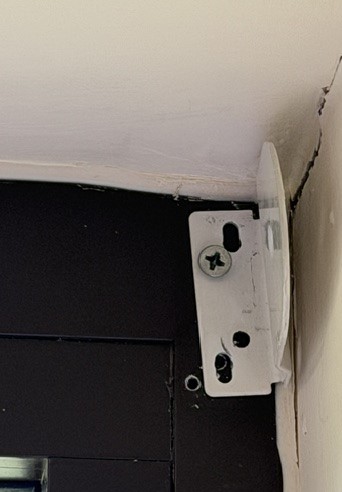
1. The brackets had been screwed directly into the window frame
Now, these were older windows, and I could see why someone might think fixing into the frame was the easiest option.
But easiest doesn't necessarily mean right.
Where suitable, we would look to fix into the surrounding recess rather than drilling unnecessary holes into the window frame.
Once those holes are there, they're there.
And depending on the window and the fixing position, there may be a better way of installing the blind.
2. One bracket was only held in place by a single screw
There were other holes where someone had obviously tried to fit a second screw.
But for whatever reason, they'd given up.
The bracket on the other side had two screws, although only one had been screwed fully home.
So neither bracket had been fitted as I would expect.
And while a customer might never notice something like that, it's exactly the sort of thing a professional fitter should be checking.
3. The blind caught the window handle every time it was operated
Because of where the brackets had been positioned, the roller blind caught the handle whenever the customers raised or lowered it.
For three years, they'd been putting up with that.
And here's the important bit.
They thought that was normal.
Think about that for a moment.
For three years, they'd been operating a blind that caught the window handle, simply assuming that's how roller blinds worked.
Nobody had explained that a correctly measured and installed blind should have suitable clearance to operate without catching the handle.
And why would they question it?
They'd paid a professional company to measure and install it.
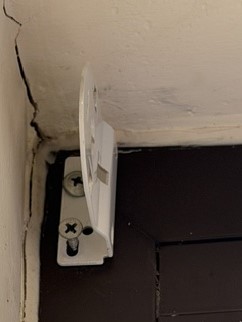
4. One of the brackets had been fitted backwards
This was the one that really surprised me.
On this particular roller blind system, the fixing holes should face inwards, where they're concealed by the blind.
But the bracket on the left had been turned around so the fixing holes were on the outside.
Why would somebody do that?
One possible explanation is that the blind had been measured too narrow, and reversing the bracket was an attempt to make it fit.
I can't know for certain.
But whatever the reason, it wasn't how that bracket was designed to be installed.
And remember, this wasn't a blind somebody had fitted themselves over a weekend.
The customer had paid a professional company to measure and install it.
"We Thought That Was Just How Blinds Were"
That was probably the most disappointing part of the whole visit.
The customers hadn't complained about the installation.
They hadn't questioned the brackets, the screws or the blind catching the handle.
They simply assumed that was how roller blinds worked.
And I can understand why.
If you employ a professional company to do a job, you naturally expect them to know what they're doing.
Most customers don't know which way a roller blind bracket should face.
They shouldn't need to.
They don't know how many screws should be holding it in place or whether there's a better fixing position.
That's what they're paying us to know.
I explained why I wasn't happy to reuse the existing installation and why I would recommend replacing the blind properly rather than simply recovering it.
Which was a shame.
Because I'd gone there hoping to save the customer money and reuse perfectly good components.
That's something we actively encourage at Barlow Blinds.
But reusing something only makes sense when it's safe, suitable and properly installed.
And in this case, I wasn't comfortable leaving the existing installation as it was.
Which Brings Me to Dave, Our New Blind Fitter
The experience in Loughborough also made me think about Dave.
Dave joined our fitting team just over two months ago, and he's been working alongside our experienced fitters ever since.
Learning how we do things.
Not just how to put a blind up.
But how to measure, position, secure and finish an installation properly.
And the blind I'd just seen in Loughborough was a good example of why that experience matters.
Because knowing how to attach a roller blind bracket to a wall is one thing.
Knowing whether that's the right place to attach it is something else entirely.
You need to understand the window you're working with.
You need to think about handles, recesses, fixing surfaces and how the blind is going to operate once it's installed.
You need to recognise when something doesn't look right.
And sometimes you need to have the confidence to stop and ask somebody rather than trying to make something fit.
That's what we want Dave to learn.
Now, after more than two months, you might reasonably ask why we haven't sent him out fitting blinds on his own yet.
After all, he's been doing the job every day.
The answer is simple.
Because we're not ready to. And neither is Dave.
That isn't a criticism of him.
Quite the opposite.
He's learning from fitters who have been doing this work for many years, and there's an enormous amount of knowledge for him to pick up.
You can't teach every possible window, awkward recess or unusual fixing problem in a couple of weeks.
Some things only come with experience.
And I'd much rather Dave spent a little longer learning alongside somebody who knows what they're doing than find himself in a customer's home, faced with something unusual, and feel he has to guess.
There's no shame in asking for help.
In fact, I'd be far more concerned about a fitter who never asked questions.
Because that's often when mistakes happen.
A Blind Can Look Fine Until You Look a Little Closer
The interesting thing about the Loughborough blind was that, at first glance, it looked like an ordinary roller blind.
The fabric was fine.
The mechanism worked.
It went up and down, even if it caught the handle along the way.
But look a little closer and the problems became obvious.
And that's something I think customers should understand when they're choosing a company to supply and fit their blinds.
The quality of the fitting matters just as much as the quality of the blind.
You can buy the best fabric, the best components and the best operating mechanism available.
But if the blind is badly measured or incorrectly installed, none of those things will make up for poor workmanship.
At Barlow Blinds, we manufacture many of the blinds we sell in our Leicester factory.
We take a great deal of care making them.
It would be rather pointless putting all that effort into manufacturing a quality blind and then rushing the installation.
And that's why we take training seriously.
Not because fitting blinds is impossibly complicated.
But because doing it properly requires more knowledge and judgement than people might realise.
What Should You Expect From a Professional Blind Fitter?
I don't think customers should need to become experts in blind installation.
But I do think they should know what they're entitled to expect.
A professionally fitted roller blind should have:
- Securely fitted brackets, using appropriate fixings for the surface they're being attached to.
- Enough clearance to operate properly, without catching window handles or other obstructions.
- Suitable fixing positions, avoiding unnecessary damage to window frames wherever practical.
- Components fitted as the manufacturer intended, rather than altered or reversed simply to make something fit.
- A tidy, properly finished installation, with the blind operating smoothly.
And before the fitter leaves, there's one very simple thing I'd encourage every customer to do.
Operate the blind yourself.
Raise it.
Lower it.
Check that it moves freely and doesn't catch anything.
If something doesn't seem right, ask about it.
A good fitter shouldn't have a problem explaining why something has been installed in a particular way.
And if there's an issue with the window, the fixing position or the blind itself, I'd much rather our fitter explained it honestly than tried to hide it or take a shortcut.
That's something we're teaching Dave from day one.
Sometimes the Best Thing We Can Do Is Say No
I went to Loughborough expecting to save somebody money by recovering a three-year-old roller blind.
Instead, I ended up explaining why I wasn't happy with the way it had been fitted.
Not the outcome I'd hoped for.
And probably not the answer the customers were expecting.
But I couldn't knowingly recommend reusing an installation that I didn't believe had been done properly.
It's also why we're taking our time with Dave.
Because the difference between someone who can put a blind up and someone who can fit one properly isn't always obvious.
Sometimes it's a bracket fitted the wrong way round.
Sometimes it's a screw that hasn't been tightened.
Sometimes it's a blind catching a window handle for three years because nobody thought to position it differently.
And sometimes it's knowing when to stop, explain the problem and find a better solution.
A professional blind fitter isn't simply somebody who knows how to put a blind up.
It's somebody who knows how to put it up properly.
And knows when something isn't right.
That's the standard we expect from our team.
And it's why Dave won't be going out on his own until we're both confident he's ready.
Because our customers shouldn't need to know which way a bracket faces, how many screws it needs or whether a blind has been positioned correctly.
That's what they're paying us to know.
About Phil Coleman
Phil Coleman is the fifth generation of his family to run Barlow Blinds, a Leicester business that has been making blinds since 1887. With over 30 years of hands-on experience, Phil has played a leading role in shaping industry standards including being part of the team that wrote the only NVQ qualification for blind and shutter installers. He also serves on the Management Committee of the British Blind & Shutter Association (BBSA), helping to set best practice across the trade. Under his leadership, Barlow Blinds has remained true to its founding principle: “It’s not our job to find customers for our blinds, it’s our job to find the right blinds for our customers.”
Article Review & Accuracy
Reviewed by: Phil Coleman, Managing Director, Barlow Blinds
Last reviewed: October 2026
Our promise
If new evidence, products or British Standards change our advice, we'll update this article. If we make a mistake, we'll correct it.
This article forms part of the Barlow Blinds Knowledge Centre and is written or personally reviewed by Phil Coleman, drawing on more than 35 years' experience, guidance from the British Blind & Shutter Association (BBSA), British Standards where applicable, manufacturer technical information and real customer feedback.
Major updates to this article are shown at the top or bottom of the page.