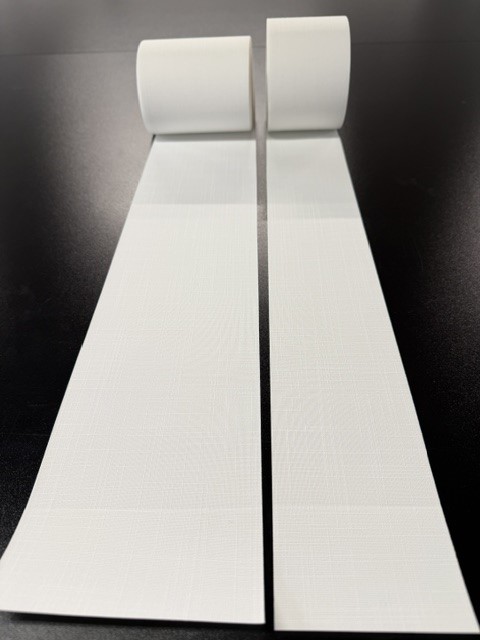
Why Have 127mm (5-Inch) Vertical Blinds Almost Disappeared?
I had a conversation with a lovely lady last week who, if I'm being fair, was getting increasingly annoyed with me.
She was looking to replace her 20-year-old vertical blinds.
Nothing particularly unusual about that. We replace older vertical blinds all the time.
But she knew exactly what she wanted.
Her existing blinds had what most people in the industry would traditionally have called 5-inch vertical louvres.
Today, we'd call them 127mm louvres.
And she wanted exactly the same again.
No problem.
Well... almost no problem.
"Why Can't I Have That Fabric in 127mm?"
I explained that we can still supply 127mm vertical blinds, but there's nowhere near the choice of fabrics you get with the more common 89mm louvre — traditionally known as 3.5-inch.
So she started going through the fabric books.
She found one she liked.
89mm only.
Another one.
Same answer.
Then another.
You can probably see why she was getting frustrated.
She wasn't asking for anything particularly exotic. She simply wanted to replace a blind she'd happily lived with for 20 years.
Eventually she looked at me and asked:
"Why on earth is there less choice in the wider fabrics?"
And I didn't have a good answer.
I've worked in the blind industry for more than 30 years, but I'd never really stopped to think about it.
In fact, from a purely practical point of view, you could make a pretty good argument for a 127mm vertical blind.
So why had something that was once so common become the unusual choice?
I decided to find out.
Because 127mm Vertical Blinds Actually Have Some Advantages
A 127mm vertical blind isn't necessarily better than an 89mm blind.
But there are some things it does very well.
Because each louvre is wider, you need fewer of them to cover the same window.
Fewer louvres means fewer gaps between them, which can help with room darkening.
When you pull the blind back, there are fewer louvres stacking at the side too, potentially leaving more of the window uncovered.
And on a large window or patio door, the proportions of a wider louvre can look really good.
So my customer's question was actually a very sensible one.
If 127mm louvres work so well, why has most of the blind industry moved towards 89mm?
As it happened, a few days later I was having Sunday lunch with exactly the right person to ask.
Sunday Lunch With Someone Who'd Know
I was meeting Steve Birtles, a former Director of Louvolite. The trusted supplier of our fabrics and components.
To find out more about Louvolite and why they are our supplier of choice click here
For more years than Steve would probably like me to mention, he was responsible for fabrics at the company.
In other words, if anyone was going to know why vertical blind louvres had changed over the years, it was Steve.
So, somewhere during Sunday lunch, I asked him the question my customer had asked me:
Why did 5-inch vertical blinds fall out of favour?
And yes, I said 5-inch.
Because when you've both been around blinds for as long as Steve and I have, that's still what you tend to call them.
His answer took us back about 50 years.
And it started with the patio door.
The Patio Door Changed Everything
During the mid-1970s and into the 1980s, patio doors were a major driver of vertical blind sales.
And when you think about it, you can see why.
Suddenly, homes had these relatively large expanses of glass that needed covering.
Curtains were an option, of course, but vertical blinds gave you something different.
You could draw them right back from the glass, rotate the louvres to control sunlight and privacy, or close them completely.
And for those big patio doors, 5-inch — or 127mm — louvres made a lot of sense.
You needed fewer louvres to cover the opening.
That meant fewer carrier trucks in the headrail.
Fewer bottom weights.
Less fabric stacked at the side when the blind was open.
And fewer components could also mean a lower manufacturing cost.
Visually, it worked too.
A big louvre looked right across a big expanse of glass.
But then vertical blinds escaped from the patio door.
We Started Putting Vertical Blinds Everywhere
As people discovered how practical vertical blinds were, they started wanting them on other windows around their homes.
Bedroom windows.
Lounge windows.
Dining room windows.
And these windows were generally much smaller than a patio door.
Suddenly that wide 127mm louvre could look a bit big.
The narrower 89mm louvre often looked better proportionally, so gradually demand started to shift.
Vertical blinds weren't simply a patio-door product anymore.
They'd become a whole-house window blind.
And the 89mm louvre increasingly became the standard.
Then the Windows Themselves Changed
Steve also made another interesting point.
Look at many houses built in the 1970s and compare their windows with those in more modern properties.
Window designs have changed.
Recesses and sills can be shallower, and modern window handles can project quite a long way into the recess.
That's important with a vertical blind because the louvre needs enough space to rotate.
A 127mm louvre doesn't just need 127mm of space. It has to turn.
If you haven't got enough depth, there's a risk of the louvre catching the window handle as it rotates.
An 89mm louvre is simply easier to accommodate in many of those situations.
So once again, the narrower louvre made sense.
But Steve mentioned something else that I'd never really considered.
There Was a Commercial Side to It Too
There's a simple bit of maths involved here.
If you're making an 89mm vertical blind, you need more louvres to cover the same width of window than you would with 127mm louvres.
And more louvres means more components.
More carrier trucks in the headrail.
More bottom weights.
More chain.
For a company manufacturing and supplying those components to the blind industry, that's not exactly bad for business.
As Steve pointed out, if the market moves towards a blind that requires more components to manufacture, and you're one of the businesses supplying those components, there's an obvious commercial benefit.
Now, I'm not suggesting there was some grand conspiracy by the blind industry to get rid of 5-inch verticals so it could sell more bottom weights.
There wasn't.
There were very good practical and aesthetic reasons why customers increasingly preferred the narrower 89mm louvre.
But commercially?
The change certainly didn't hurt the companies supplying the parts.
And there was another advantage to the narrower fabric that was sitting right under my nose.
Or, more accurately, right there in the fabric book.
You Can Fit More Fabrics in the Book
This is one of those obvious things that you don't really think about until somebody points it out.
The old 5-inch fabric books could fit two 127mm fabric samples side by side.
With 89mm fabrics, Louvolite can fit three samples side by side.
That's a 50% increase in the number of samples you can show across the same page.
And across an entire fabric book, that's significant.
Suddenly, you can physically show customers far more colours, patterns and textures without producing a huge pattern book.
And that brought me straight back to my customer.
She'd been sitting there turning through page after page of fabrics, wondering why so many of the ones she liked weren't available in the wider 127mm size.
Part of the answer was literally in her hands.
As demand moved towards 89mm louvres, fabric manufacturers naturally concentrated more of their collections on that size.
And because you could fit more 89mm samples into a book, you could physically present a much broader choice to the customer too.
The more popular size got more choice.
And the greater choice made the more popular size even easier to sell.
So Why Is There Less Choice in 127mm Fabrics Today?
Once you put all of this together, it starts to make sense.
Vertical blinds began life covering lots of large patio doors, where the wider 127mm louvre worked extremely well.
Then people started putting vertical blinds on smaller windows around the home.
The narrower 89mm louvre often looked more proportional.
Window designs changed, making the narrower louvre easier to accommodate.
Manufacturers supplying the components benefited from a blind requiring more carriers, weights and other parts.
Fabric suppliers could fit more 89mm samples into their books.
And, most importantly, that's where customer demand went.
So the fabric collections followed.
That's ultimately why my customer wasn't imagining things.
There genuinely is much less choice in 127mm vertical blind fabrics today.
Louvolite is one of the relatively few suppliers that continues to offer fabrics in both 89mm and 127mm widths, which means we can still manufacture the traditional wider vertical blind.
You just won't get anything like the same breadth of fabric choice.
Which raises the obvious question.
Should You Choose 89mm or 127mm Vertical Louvres?
I don't think there's a universally "better" option.
It depends on the window and what matters most to you.
If you're covering a large window or patio door, don't dismiss 127mm louvres simply because 89mm has become the industry standard.
The wider louvres still have genuine advantages.
You need fewer of them.
There are fewer joins and gaps across the blind.
They can provide excellent light and privacy control.
And when you draw the blind back, the smaller number of louvres can mean less material stacked at the side.
But there are compromises.
The biggest is fabric choice.
If you've got a very particular colour, pattern or texture in mind, you're much more likely to find it in an 89mm fabric.
And if your window recess is shallow or you've got handles projecting into it, 89mm may also be the more practical choice.
So I'd look at the window first rather than automatically deciding that one size is better than the other.
Large opening where stack size and fewer louvres matter?
I'd certainly look at 127mm.
Smaller window, restricted clearance or maximum fabric choice?
89mm will probably give you more options.
Sometimes Customers Ask the Best Questions
I've been working with blinds for more than 30 years.
We still manufacture vertical blinds ourselves here in Leicester.
And yet it took a customer standing in front of me with a fabric book asking:
"Why on earth is there less choice in the wider fabrics?"
for me to realise that I didn't actually know the full answer.
I knew what had happened.
The old 3.5-inch — today's 89mm — had become the industry standard.
But I'd never really asked why.
So I asked someone who'd been there as the industry changed.
And what started as a slightly frustrating conversation about a fabric book turned into a surprisingly interesting lesson in the history of the vertical blind.
The windows changed.
The places we used vertical blinds changed.
Our tastes changed.
There were commercial advantages to the narrower louvre.
Even the humble fabric book played its part.
And eventually the market followed.
The 5-inch vertical blind didn't disappear because there was something wrong with it.
In fact, on the right window, some of the things that made the 127mm louvre such a good solution 40 or 50 years ago still make it a good solution today.
It just stopped being the solution most people chose.
And if you're one of the people who still prefers what Steve and I will probably always think of as a traditional 5-inch vertical blind?
You can absolutely still have one.
You'll just have fewer fabrics to choose from when you open the book.

About Phil Coleman
Phil Coleman is the fifth generation of his family to run Barlow Blinds, a Leicester business that has been making blinds since 1887. With over 30 years of hands-on experience, Phil has played a leading role in shaping industry standards including being part of the team that wrote the only NVQ qualification for blind and shutter installers. He also serves on the Management Committee of the British Blind & Shutter Association (BBSA), helping to set best practice across the trade. Under his leadership, Barlow Blinds has remained true to its founding principle: “It’s not our job to find customers for our blinds, it’s our job to find the right blinds for our customers.”
Article Review & Accuracy
Reviewed by: Phil Coleman, Managing Director, Barlow Blinds
Last reviewed: September 2026
Our promise
If new evidence, products or British Standards change our advice, we'll update this article. If we make a mistake, we'll correct it.
This article forms part of the Barlow Blinds Knowledge Centre and is written or personally reviewed by Phil Coleman, drawing on more than 35 years' experience, guidance from the British Blind & Shutter Association (BBSA), British Standards where applicable, manufacturer technical information and real customer feedback.
Major updates to this article are shown at the top or bottom of the page.