7 Questions to Ask Before Choosing a Blind Company in Leicester
Buying new blinds should be fairly straightforward.
You arrange for somebody to visit your home, look at a few samples, choose something you like, get a price and have your new blinds fitted.
Simple.
Except there's quite a lot going on behind the scenes that most customers never think to ask about.
And some of those things can make a real difference to how happy you are with your blinds five or ten years down the line.
I've worked in the blind industry for over 35 years, and if there's one thing I've learned, it's this:
Two blinds that look almost identical when they're fitted can be very different products.
The same goes for the companies selling them.
Here in Leicester, some companies manufacture their own blinds. Others buy from manufacturers elsewhere in the UK or overseas.
Some employ their own fitters. Others use subcontractors.
Some can repair a blind when something goes wrong. Others can only offer to replace it.
And some give you their best price straight away, while others seem to expect you to negotiate.
Now, none of those differences automatically makes one company better than another.
But they are things you deserve to know before spending your money.
So, whether you're considering Barlow Blinds or another company in Leicester or Leicestershire, here are seven questions I'd encourage you to ask.
And yes, I'd encourage you to ask us these questions too.
1. Where Are Your Blinds Actually Made?
This is probably the question I'd most like customers to ask.
Not because I believe every blind needs to be made locally.
It doesn't.
There are some excellent blinds manufactured elsewhere in the UK and overseas.
But knowing where your blinds come from can tell you quite a lot about the company you're buying from.
Over the last 30 years, I've watched the number of companies manufacturing blinds here in Leicestershire fall dramatically.
There used to be around a dozen local manufacturers.
Today, I can only think of three.
Yet the number of businesses selling and fitting blinds has increased considerably.
There's nothing necessarily wrong with that.
But there's a difference between a company that manufactures a product and one that orders it from somebody else.
And that difference can matter when something needs adjusting, repairing or replacing.
What we manufacture at Barlow Blinds
At our Leicester factory, we manufacture our roller blinds, vertical blinds and many of our cellular and Perfect Fit blinds.
That gives us direct control over the components, the assembly process and the quality checks.
For example, our roller blind fabrics are cut using a specialist Crush Cut table.
Rather than simply slicing through the material, the cutting process helps seal the fabric edges as they're cut.
Our vertical blind louvres are hand-sewn rather than simply glued.
And we've recently invested £20,000 in specialist machinery to improve the accuracy of our cellular blind production.
Now, does every customer need to know what a Crush Cut table is?
Probably not.
But I think customers should know there's more to making a blind than cutting a piece of fabric and attaching a mechanism.
The way a blind is manufactured can affect its appearance, operation and long-term durability.
But we don't manufacture everything
And I'm perfectly happy to admit that.
Our shutters, wooden Venetian blinds and certain other specialist products come from manufacturers we've chosen to work with.
We don't pretend otherwise.
If you ask where a particular product comes from, we'll tell you.
In fact, I'd be suspicious of any company that couldn't give you a straight answer.
My advice: Ask where your particular blinds will be manufactured, who makes them and whether the company has any direct control over the manufacturing process.
Don't assume everything a company sells comes from the same place.
2. Who Will Actually Fit My Blinds?
Here's something that surprises quite a few customers.
The person who visits your home to measure your windows isn't necessarily the person who comes back to install your blinds.
And the fitter might not even work for the company you've bought them from.
Now, subcontracting isn't automatically a problem.
There are some excellent independent blind installers.
The important question is who takes responsibility if something goes wrong.
Because a good blind, badly fitted, is still a badly fitted blind.
A blind I saw in Loughborough
I recently visited a home in Loughborough where the customers wanted to replace the fabric on a three-year-old roller blind.
The blind itself was working perfectly well.
The installation was another matter.
The brackets had been screwed directly into the window frame.
One bracket had only a single screw holding it.
And every time the blind was operated, it caught the window handle.
When I first looked at it, I wondered whether the customer had fitted it themselves.
They hadn't.
It had been professionally installed.
And that's something worth remembering.
Professionally fitted doesn't automatically mean properly fitted.
When you pay somebody to install blinds, you're not just paying for someone who knows how to use a drill.
You're paying for their judgement.
Where should the brackets go?
Will the blind clear the window handles?
Is the fixing suitable for the surface?
Will everything operate properly once the installer has left?
These things matter.
How we handle installation
At Barlow Blinds, our fitters are employed directly by us.
They're experienced, DBS-checked and trained to our installation standards.
And if there's a problem with the fitting, it's our responsibility to put it right.
There's no argument about whether the installer or the supplier should deal with it.
But I wouldn't tell you to avoid a company simply because it uses subcontractors.
I'd tell you to find out how those subcontractors are selected, trained and held accountable.
My advice: Ask who will actually fit your blinds, what experience they have and who takes responsibility if something isn't right.
A company should be able to answer all three questions without hesitation.
3. Can My Blinds Be Repaired, or Will I Have to Replace Them?
Nobody buys a new blind expecting it to break.
I understand that.
When you're choosing fabrics and colours, the last thing you're thinking about is whether you'll be able to get a replacement mechanism in eight years.
But perhaps you should be.
Because blinds are mechanical products.
They contain moving parts, gears, cords, mechanisms and sometimes motors.
And eventually, something may need attention.
The question is what happens then.
Do you replace a small component?
Or do you have to throw away the entire blind?
Why repairability matters
Because we manufacture many of our blinds here in Leicester, we can often replace individual components rather than the complete product.
We've repaired blinds that are well over 15 years old.
We've also replaced the fabric on existing roller blinds while keeping the original tubes, brackets and operating mechanisms.
Think about that for a moment.
If the mechanism is working perfectly well and the customer simply wants a different fabric, why throw everything else away?
It doesn't make much sense to me.
Replacing the fabric can save the customer money and prevent perfectly good components from ending up in the bin.
Unfortunately, not every blind is designed with repairability in mind.
Some imported blinds use components that are difficult or impossible to obtain separately.
Others are assembled in ways that make dismantling them impractical.
That doesn't automatically make them bad blinds.
But it can make them more expensive to own over time.
And I think customers deserve to know that before buying.
Can we repair any blind?
No.
We generally only undertake repairs on blinds we've manufactured or installed ourselves.
That's because we know the components, construction methods and systems involved.
With an unfamiliar blind, we can't always guarantee that the correct parts are available or that a repair would be practical.
I'd rather be upfront about that than promise something we might not be able to deliver.
My advice: Ask whether replacement components will be available in five or ten years.
And ask whether the company offers repairs after the original guarantee has expired.
A blind that costs slightly more today but can be repaired in the future may work out considerably cheaper in the long run.
4. What Does Your Guarantee Actually Cover?
Most blind companies offer some kind of guarantee.
Two years. Three years. Five years.
Sometimes longer.
And naturally, customers tend to assume that the longer the guarantee, the better.
But here's the question I'd ask.
What actually happens if something goes wrong?
Because a five-year guarantee might sound wonderful until you discover it only covers a replacement component.
Not the cost of somebody visiting your home.
Not the labour involved in fitting it.
And perhaps not even the cost of getting the blind back to the manufacturer.
Suddenly, that impressive-sounding guarantee doesn't seem quite so impressive.
Three things every customer should check
Before ordering, ask:
- How long does the guarantee last?
- Does it cover both parts and labour?
- If something goes wrong, will somebody come back to your home to put it right?
I'd also ask whether there are any exclusions worth knowing about.
And I'd want the terms in writing.
Our approach at Barlow Blinds
We offer a two-year on-site guarantee on our blinds and a five-year guarantee on our shutters and awnings, subject to the relevant guarantee terms.
If there's a covered problem with one of our blinds during that two-year period, we arrange to put it right.
Customers shouldn't have to become blind mechanics just because something has stopped working.
Now, you'll find companies advertising longer guarantees than ours.
That's fine.
But I'd encourage you to compare what those guarantees actually include rather than looking at the number of years alone.
And there's one more thing worth considering.
A guarantee is only useful if the company is still around to honour it.
My advice: Ask for the guarantee terms before placing your order.
Find out exactly what happens if something goes wrong, who pays for the labour and whether you'll need to remove or return the blind yourself.
5. Are Your Blinds Child-Safe, and How Will You Make Sure?
Of all the questions in this article, this is the one I feel most strongly about.
Because when it comes to child safety, there really isn't room for compromise.
Blind cords and chains can present a serious strangulation risk to young children.
That's why there are product safety requirements governing the manufacture and installation of internal blinds.
And yet, after more than 35 years in this industry, I still come across installations that concern me.
A conversation I had in Syston
I visited a home in Syston where the customer wanted vertical blinds with traditional cord and chain operation.
The customer told me that two other companies had suggested they could sign a disclaimer to allow the blinds to be fitted in the way they wanted.
I explained that signing a disclaimer doesn't remove the requirement to supply and install a compliant product.
We wouldn't fit them that way.
Now, I appreciate that customers sometimes have a particular style or operating system in mind.
Perhaps they've had the same type of blind for years.
Perhaps they're replacing an existing blind and want something familiar.
But safety has to come first.
Fortunately, there are now plenty of alternatives.
Wand-operated vertical blinds.
Cordless cellular blinds.
Perfect Fit systems.
Motorised roller blinds.
And in many situations, these aren't just safer options.
They're also easier to operate and can look neater.
What should your blind company explain?
A professional company should be able to explain how your chosen blinds will comply with the relevant child safety requirements.
They should explain any safety devices, operating restrictions or installation requirements that apply.
And they shouldn't treat those requirements as optional extras.
At Barlow Blinds, we're members of the British Blind and Shutter Association (BBSA), which provides industry guidance and training to help members stay informed about product safety.
My advice: Ask how the company will make your chosen blinds child-safe and compliant.
If somebody suggests that signing a disclaimer is an acceptable alternative to a safe installation, I'd be looking elsewhere.
6. Is That Your Best Price, or Am I Expected to Negotiate?
Here's something about the blinds industry that's bothered me for years.
Why should two customers pay completely different prices for the same blinds simply because one is better at negotiating?
I visited a customer in Whetstone who'd already received a quotation from a national blind company.
Six vertical blinds.
The original quote was around £1,800.
After some discussion, the price had dropped to approximately £750.
That's a reduction of more than £1,000.
Now, I wasn't there for the conversation, and I don't know the reasons behind that company's pricing.
There may have been perfectly reasonable explanations.
But here's the question I'd be asking if I were the customer.
If £750 was an acceptable price, why start at £1,800?
And what happens to the customer who doesn't negotiate?
The person who simply trusts the original quotation?
That's what troubles me about this approach.
Buying blinds shouldn't feel like a test of your negotiating skills.
How we price our blinds
At Barlow Blinds, we don't work on commission.
We don't start with inflated prices just so we can offer dramatic discounts.
We give customers our best price from the beginning.
For products such as vertical blinds, we can explain the differences between our standard, deluxe and luxury options.
We can show you why one costs more than another.
And because we manufacture many of our blinds ourselves, we can often explain the differences in materials, mechanisms and construction.
Will we always be the cheapest?
No.
And if the lowest possible price is your main priority, another company might be a better fit.
There's nothing wrong with that.
But I'd rather lose an order because somebody finds a cheaper product than win one by making them feel they've negotiated a bargain.
I believe customers should know what they're paying for.
And I don't believe a fair price should depend on how confidently somebody can negotiate.
My advice: Ask whether the quotation is the company's best price.
Find out exactly what's included, whether fitting is extra and why the product costs what it does.
Don't just compare discounts.
Compare what you're actually getting.
7. Does the Company Have Any Independent Accreditations?
Every company can tell you how wonderful it is.
We certainly talk about the things we do well.
But let's be realistic.
A business saying it's trustworthy doesn't automatically make it trustworthy.
I'd much rather see independent evidence.
Professional memberships.
Recognised accreditations.
Genuine customer reviews.
And, perhaps most importantly, how the company behaves when something goes wrong.
What should you look for?
At Barlow Blinds, we're members of the British Blind and Shutter Association.
That involves commitments to professional standards, industry guidance, insurance requirements and a code of conduct.
Customers also have access to the association's mediation service should a dispute arise.
We're also a Which? Trusted Trader and have held that endorsement since 2017.
That involves an independent assessment process rather than simply paying to display a logo.
We've also been fortunate enough to receive recognition through the BBSA Excellence Awards.
We're proud of those things.
But I wouldn't expect you to choose us just because we've mentioned them.
I'd encourage you to check the memberships yourself.
Read the reviews.
And don't just read the five-star ones.
Pay attention to the unhappy customers
Nobody gets everything right all the time.
We certainly wouldn't claim to.
Sometimes mistakes happen.
Products develop faults.
Installations need adjusting.
Customers aren't always happy.
The important question is what the company does next.
Do they answer the telephone?
Do they take responsibility?
Do they try to resolve the problem?
Or do they disappear once they've been paid?
In my experience, the way a company deals with a problem can tell you far more than a hundred glowing marketing claims.
My advice: Check that accreditations are current, read independently verified reviews and find out whether the company has a proper complaints process.
And look particularly closely at how it responds when things don't go to plan.
So, How Do You Choose the Best Blind Company in Leicester?
I'd be very wary of any article claiming to tell you who the best blind company in Leicester is.
Including one written by a blind company.
Because the truth is, there isn't one company that's going to be the best choice for absolutely everybody.
Different customers want different things.
Some want the lowest possible price.
Others want a particular fabric, a specialist product or something unusual made to measure.
Some want a company that manufactures locally.
And others simply want the reassurance that if something goes wrong in five years' time, somebody will still answer the telephone.
Those are all perfectly reasonable priorities.
The important thing is understanding what you're comparing.
Two blinds can look the same but be very different
Imagine getting two quotations for what appears to be the same roller blind.
One is £50 more expensive.
Naturally, you might wonder why you'd pay the extra.
And sometimes, there may be no good reason.
But the more expensive blind might include a better-quality mechanism, a stronger roller tube, a different fabric-cutting process, professional installation and access to replacement components.
Or it might not.
That's why asking questions matters.
Because you can't necessarily tell the difference just by looking at the finished blind.
And you certainly can't tell by looking at a fabric sample.
When might Barlow Blinds not be the right choice?
I think it's important to answer that question too.
If your only priority is finding the absolute cheapest blinds available, we're unlikely to win every quotation.
We don't pretend otherwise.
And if you're looking for a product we don't manufacture ourselves, we'll explain where it comes from rather than suggest everything is made in our Leicester factory.
There may also be situations where another company offers a product, specification or service that's a better fit for what you need.
That's fine.
I'd much rather help somebody make the right decision than persuade them to buy something that isn't suitable.
Because ultimately, a satisfied customer is worth far more than an order we should never have taken.
Your Checklist: 7 Questions to Ask Every Blind Company
Before placing an order, keep these questions handy.
- Where are my blinds made? Does the company manufacture them or buy them from another supplier?
- Who will fit them? Are the installers employed directly, and who takes responsibility for the work?
- Can they be repaired? Will replacement parts be available in the future?
- What does the guarantee cover? Are parts, labour and home visits included?
- How will you ensure they're child-safe? Can the company explain the relevant safety requirements?
- Is this your best price? What's included, and are there any additional charges?
- What independent evidence supports your claims? Can you verify accreditations, memberships and customer reviews?
Ask these questions of every company you're considering.
Including us.
A good company shouldn't be uncomfortable answering them.
In fact, I'd argue it should welcome the opportunity.
A Final Thought From Someone Who's Been Making Blinds for Over 35 Years
I've seen a lot change in this industry.
Fabrics have improved.
Mechanisms have evolved.
Motorisation has become more accessible.
Manufacturing technology has moved forward enormously.
But one thing hasn't changed.
People want to feel confident that they're spending their money wisely.
They want somebody who'll give them straightforward advice, explain the options and stand behind the work.
And they don't want unpleasant surprises after the blinds have been fitted.
That's why I believe choosing a blind company should involve more than comparing fabric samples and looking at the final price.
The cheapest blind isn't always the best value. And the most expensive isn't automatically the best quality.
The right company is the one that can explain what you're buying, why it's suitable for your home and what happens if something goes wrong.
If they can answer those questions clearly, you're probably on the right track.
And if they can't?
After 35 years in this industry, I'd probably keep looking.
Thinking About New Blinds in Leicester or Leicestershire?
If you're considering made-to-measure blinds and would like some straightforward advice, we're always happy to talk through your options.
We can explain which blinds we manufacture ourselves, which products we source from specialist suppliers, how they're fitted and what you're paying for.
And if something isn't right for your home or your budget, we'll tell you.
No pressure. Just advice to help you make the right decision.
About Phil Coleman
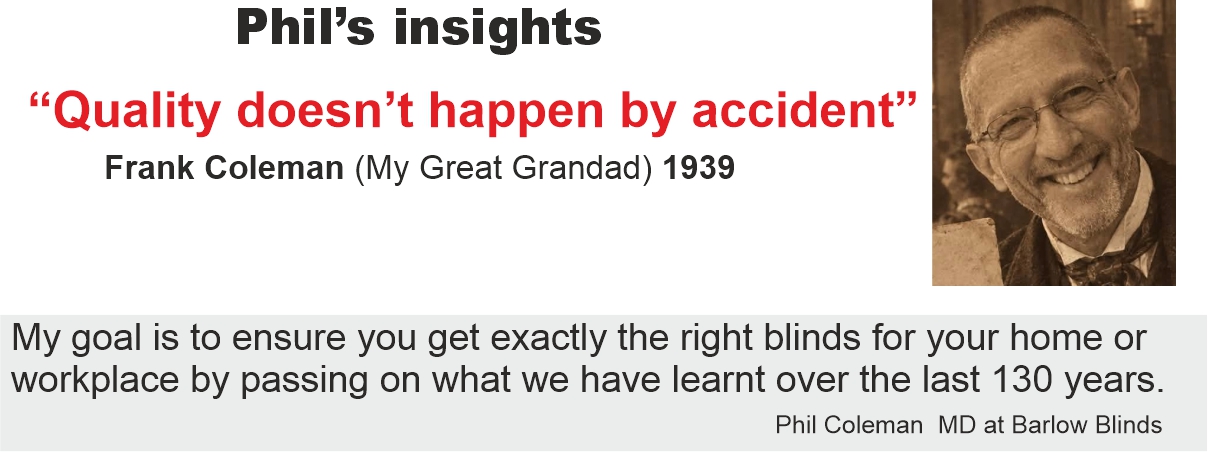
Phil Coleman is the fifth generation of his family to run Barlow Blinds, a Leicester business that has been making blinds since 1887. With over 30 years of hands-on experience, Phil has played a leading role in shaping industry standards including being part of the team that wrote the only NVQ qualification for blind and shutter installers. He also serves on the Management Committee of the British Blind & Shutter Association (BBSA), helping to set best practice across the trade. Under his leadership, Barlow Blinds has remained true to its founding principle: “It’s not our job to find customers for our blinds, it’s our job to find the right blinds for our customers.”
Article Review & Accuracy
Reviewed by: Phil Coleman, Managing Director, Barlow Blinds
Last reviewed: October 2026
Our promise
If new evidence, products or British Standards change our advice, we'll update this article. If we make a mistake, we'll correct it.
This article forms part of the Barlow Blinds Knowledge Centre and is written or personally reviewed by Phil Coleman, drawing on more than 35 years' experience, guidance from the British Blind & Shutter Association (BBSA), British Standards where applicable, manufacturer technical information and real customer feedback.
Major updates to this article are shown at the top or bottom of the page.