Bathrooms Don’t Care What Looks Good in a Sample Book
Bathrooms are one of the harshest environments in your home.
Steam.
Condensation.
Sudden temperature swings.
And yet people still fit blinds that were never designed for it.
Recently, I was asked to look at a bathroom roller blind that wasn’t even a year old.
It had been fitted correctly.
It hadn’t been mistreated.
But along the bottom edge?
Black mould.
Creeping up the sides.
Staining the fabric.
The issue wasn’t installation.
It was the material.
The fabric contained cotton.
And cotton + steam = slow failure.
Not immediately dramatic.
Not overnight.
Just quiet damage building up until the blind is beyond saving.
No one tells you that when you’re flicking through sample books.
The Part No One Mentions When Ordering Bathroom Blinds
Not all roller blind fabrics are created equal.
Some contain cotton.
Cotton absorbs moisture.
In a bathroom, that moisture lingers.
It doesn’t disappear.
Over time, mould moves in.
And by the time you see it, it’s too late.
Here’s the simplest rule you can follow:
If it contains cotton, don’t put it in a bathroom.
If a supplier can’t clearly tell you what the fabric is made of, that’s your sign to keep asking questions.
Bathrooms are unforgiving.
They don’t care how nice your blind looks or how well it goes with your new tiles.
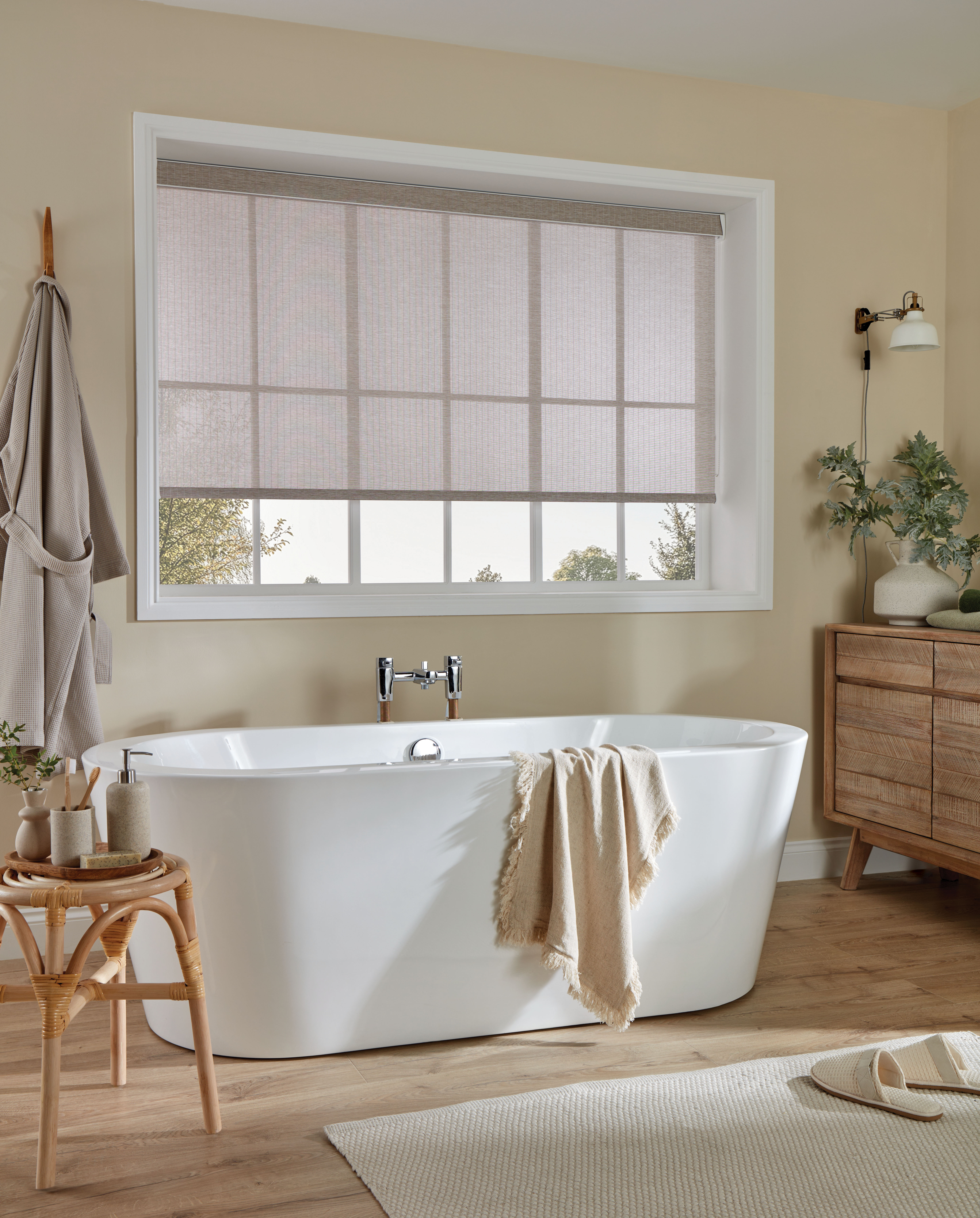
The Best Blinds for Bathrooms (That Actually Last)
Let’s cut through it.
1️⃣ Roller Blinds But Only If the Fabric Is Right
Roller blinds are popular for a reason. They’re clean, simple, and practical.
But fabric choice is everything.
Best option:
✔ PVC fabrics – completely waterproof
✔ Perfect for windows near showers, baths, and sinks
Also suitable:
✔ 100% polyester fabrics are fine in humid rooms where the blind won’t get directly wet
Avoid:
✘ Any fabric with cotton content
When made with the right material, roller blinds can last years without issue.
When made with the wrong one, they don’t stand a chance.
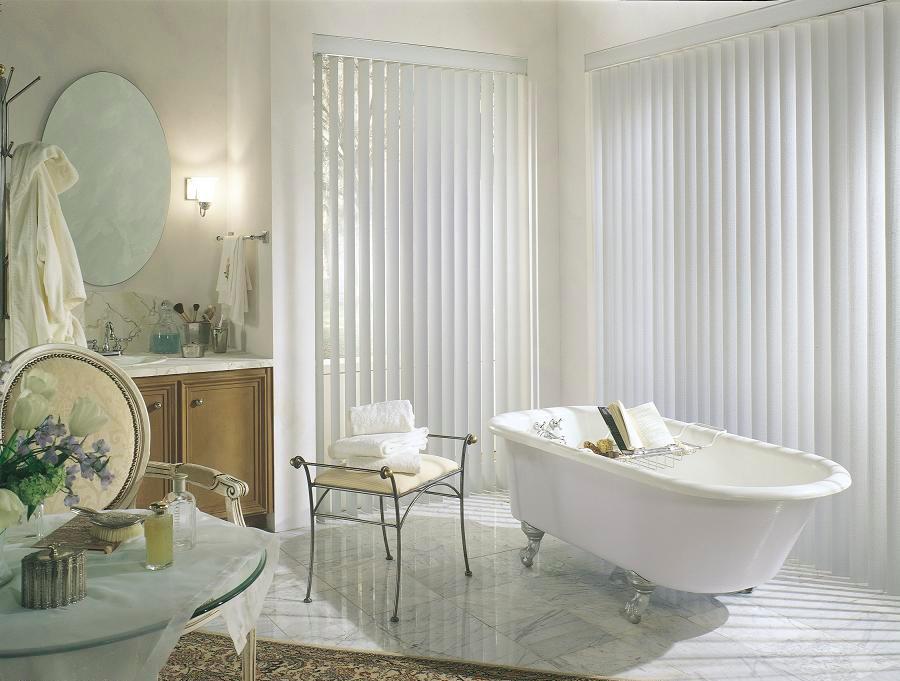
2️⃣ Vertical Blinds
Vertical blinds use many of the same fabrics as rollers.
So the same rule applies:
✔ PVC vertical fabrics = fully waterproof
✔ Polyester fabrics = moisture resistant
They’re particularly useful for larger bathroom windows.
Simple. Functional. Low risk.
3️⃣ Faux Wood Venetian Blinds
Wooden Venetians are everywhere right now.
They look great.
But real timber in a steamy bathroom?
That’s asking for movement.
Warping.
Swelling.
Natural wood reacts to moisture. It always has.
If you love the wood look, here’s the smart option:
✔ Faux wood Venetians
✔ Made from rigid PVC
✔ Completely waterproof
✔ Won’t warp, crack or swell
They look like timber.
They behave like plastic.
In a bathroom that’s a compliment.
4️⃣ Aluminium Venetian Blinds
Often overlooked.
But very hard to fault.
✔ Completely moisture resistant
✔ Slim, modern appearance
✔ Easy to wipe clean
If your bathroom produces serious steam, aluminium handles it without complaint.
The only issue over time is most Aluminium Venetian blinds have steel bottom bars that add extra weight to the blind making it smoother to raise and lower.
Problem is steel and water or steam don’t mix.
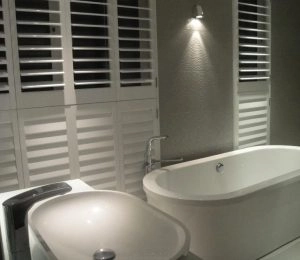
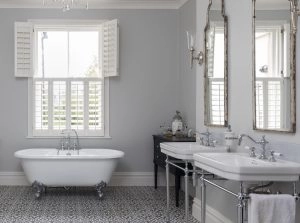
5️⃣ Bathroom Shutters
Shutters work beautifully in bathrooms when they’re the right material.
✔ Fauxwood or vinyl shutters are 100% waterproof
✔ Ideal for high-humidity spaces
✔ Easy to maintain
One of the biggest advantages with shutters?
You can close the lower panels for privacy while keeping the top open for light.
That flexibility is hard to beat.
6️⃣ Waterproof Day & Night Blinds
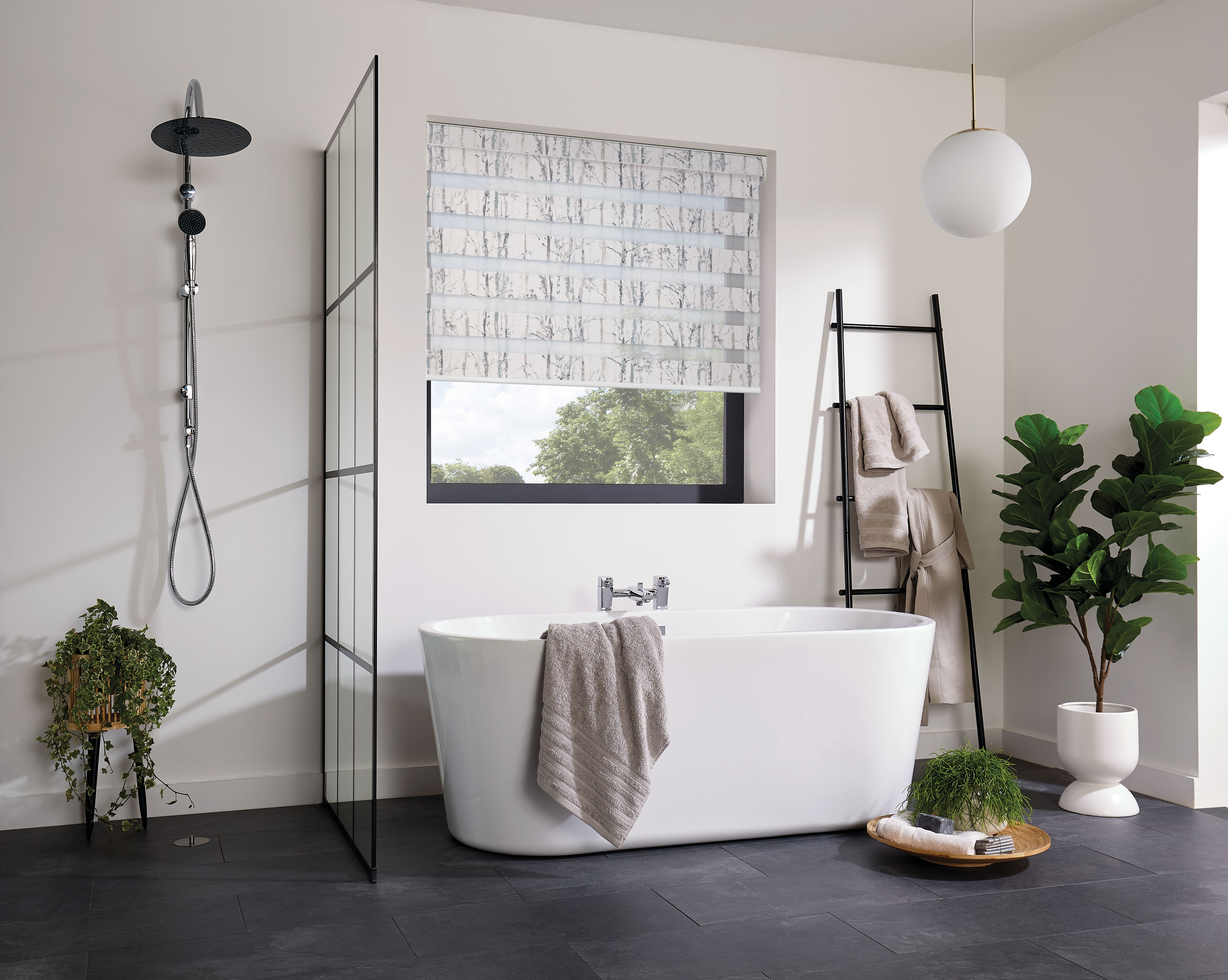
Day & Night blinds (sometimes called zebra blinds) give you flexible light control, privacy and softness in one system.
But standard versions often contain fabric blends that don’t belong in a bathroom.
If you’re considering them for a steamy space, make sure they are:
✔ Specifically manufactured in waterproof PVC
✔ Designed for humid environments
✔ Free from cotton content
When made correctly, waterproof Day & Night blinds can work well in bathrooms.
When they’re not?
You’re back to the same moisture problem.
As always ask what they’re made from.
7️⃣ Waterproof Cellular Blinds
Cellular (honeycomb) blinds are known for insulation and softness.
Standard versions?
Often fabric-based.
Often not bathroom-friendly.
However, waterproof cellular blinds are available designed specifically for humid rooms.
✔ Made from moisture-resistant materials
✔ Suitable for bathrooms when specified as waterproof
✔ Good option where insulation is important
Just don’t assume all cellular blinds are safe in a bathroom.
Most aren’t.
It has to be the waterproof version.
Blinds to Think Twice About
Let’s be honest.
Some styles simply aren’t designed for bathrooms.
❌ Real Wooden Venetian Blinds
Natural timber will react to moisture. It’s not “if.” It’s “when.”
❌ Roman Blinds
Traditionally made from curtain fabrics. Often high in cotton.
We have installed Roman blinds in bathrooms when requested.
But we always explain the long-term risk clearly.
Because if moisture affects them over time, that shouldn’t be a surprise to anyone.
Transparency matters more than the sale.
Frequently Asked Questions
Are blinds a good idea in a bathroom?
Absolutely if you choose the right material.
Waterproof roller blinds.
PVC vertical blinds.
Fauxwood Venetians.
Aluminium Venetians.
Vinyl shutters.
The key is moisture resistance. Not style alone.
Do bathroom blinds go mouldy?
Some do.
Roller and Roman blinds with cotton content can develop mould in steamy conditions.
But PVC fabrics, polyester fabrics, faux wood Venetians and vinyl shutters will not go mouldy under normal bathroom conditions.
Material is the difference.
What kind of blinds can I put in a bathroom?
Safe options include:
✔ PVC Roller Blinds
✔ Polyester Roller Blinds (if not directly wet)
✔ PVC Vertical Blinds
✔ Faux Wood Venetian Blinds
✔ Aluminium Venetian Blinds
✔ Fauxwood / Vinyl Shutters
✔ Waterproof Cellular Blinds (where specified)
Always ask one simple question:
“What is this made from?”
Not “What colour is it?”
Not “Will it look nice?”
What is it made from?
Because the difference between a blind that lasts 10 years…
and one that moulds in 18 months…
Is usually invisible in the sample book.
About Phil Coleman
Phil Coleman is the fifth generation of his family to run Barlow Blinds, a Leicester business that has been making blinds since 1887. With over 30 years of hands-on experience, Phil has played a leading role in shaping industry standards including being part of the team that wrote the only NVQ qualification for blind and shutter installers. He also serves on the Management Committee of the British Blind & Shutter Association (BBSA), helping to set best practice across the trade. Under his leadership, Barlow Blinds has remained true to its founding principle: “It’s not our job to find customers for our blinds, it’s our job to find the right blinds for our customers.”