
From Victorian Leicester to Modern Smart Shading: Why Blinds Matter More Than Ever
Originally inspired by an article featuring Barlow Blinds in the Winter 2023 edition of the British Blind and Shutter Association’s Openings magazine.
Window blinds have changed dramatically over the last 100 years.
But the problems they solve?
Those have barely changed at all.
Back in Victorian Leicester, homeowners used external awnings and blinds to keep heat out, reduce glare and create more comfortable living spaces. Privacy mattered. Cooler rooms mattered. Better sleep mattered.
And honestly, those same conversations are still happening today.
The difference is that modern homes now create entirely new challenges that older homes rarely had to deal with.
Larger expanses of glazing.
South-facing extensions.
Bifold doors.
Roof lanterns.
Open-plan spaces.
Highly insulated construction.
Modern homes are brighter than ever.
But many are also significantly harder to keep comfortable.
We regularly visit beautiful homes across Leicester where customers tell us things like:
“This room becomes unbearable after 2pm.”
“The glare on my screen is awful when I’m working from home.”
“We spent thousands on this extension but avoid sitting in it during summer.”
Or:
“Our child wakes up at 5am every morning because the blackout blinds still let light in.”
That is why shading products matter more today than they perhaps ever have before.
And it is also why it was such a proud moment for Barlow Blinds to be featured in the Winter 2023 edition of the British Blind and Shutter Association’s Openings magazine in an article called “A Shading Time Machine!”
Because when you look back through the history of blinds and shading, something becomes very clear:
Good shading has never simply been about decoration.
It has always been about comfort.
Leicester Homes Have Always Needed Shading
The photographs featured in the original article show just how common shading products once were across Leicester and the wider UK.
Traditional awnings outside shopfronts.
External blinds helping reduce heat before air conditioning existed.
Simple roller systems fitted to terraced homes.
Long before modern conversations about “overheating” and “solar gain,” people already understood an important truth:
Sunlight can completely change how a room feels.
Older generations may not have used today’s terminology, but they absolutely understood the problem.
And in many ways, modern housing is now rediscovering what they already knew.
Because while large glazed spaces create stunning homes, they also trap heat incredibly effectively.
That is why shading is becoming less about finishing touches and more about home performance.
From Decoration to Home Performance
For years, blinds were often sold the same way people buy paint colours or cushions.
Choose a fabric.
Match the room.
Add some privacy.
Job done.
But the conversation has changed.
Today, more homeowners are realising that blinds affect far more than appearance.
They affect:
- heat
- glare
- sleep
- comfort
- energy efficiency
- wellbeing
- even whether certain rooms are usable during summer
And the research increasingly supports this shift.
The British Blind and Shutter Association has been heavily involved in research into:
- overheating in homes
- solar gain
- energy efficiency
- glare reduction
- sleep quality
- wellbeing

Because modern homes are facing a very different challenge than many homes did 30 years ago.
It is no longer simply about keeping homes warm.
In many cases, it is about preventing them from becoming too hot.
Some Problems Never Change
Despite all the technology advances, the conversations we have with homeowners today are surprisingly similar to the conversations people probably had generations ago.
People still want:
- privacy without losing natural light
- cooler rooms in summer
- comfortable bedrooms
- less glare
- practical solutions that genuinely improve daily life
The products have changed.
The problems have not.
What has changed dramatically is the number of solutions available.
Motorised blinds.
Cellular blinds.
External shading systems.
Roof lantern blinds.
Smart controls.
Blackout systems.
And honestly, that can sometimes make choosing blinds more confusing than ever.
Because the best blind is rarely the most expensive blind.
It is the blind that solves the problem properly.
Sometimes that means blackout cellular blinds for someone struggling with sleep.
Sometimes it means external shading for an overheating extension.
Sometimes it means glare reduction for a home office.
And sometimes it means steering someone away from a product that simply is not right for the room.
That is where honest advice matters.
What More Than 100 Years Teaches You
At Barlow Blinds, we have been manufacturing blinds in Leicester since 1887.
And after more than a century in homes, one thing becomes very obvious:
Every room behaves differently.
A blind that works perfectly in one home may be completely wrong for another.
That customer-first thinking has always been part of our business.
My grandad Alan Coleman used to say:
“It is not our job to find customers for our blinds. It is our job to find the right blinds for our customers.”

Nearly 60 years later, that philosophy still guides how we work today.
Because homeowners do not need more sales pressure.
They need clearer advice.
Modern Homes Need Smarter Shading
One thing the original Openings article highlights beautifully is how shading products evolve alongside the homes around them.
As homes change, shading changes too.
Today, some of the biggest trends we are seeing include:
Overheating Protection
Modern glazing creates brighter living spaces but can also create rooms that become extremely uncomfortable during warmer months without proper shading.
Better Sleep Solutions
Many homeowners are now discovering that standard “blackout” blinds often still allow large amounts of light around the edges.
Energy Efficiency
Research supported by the BBSA continues to explore how shading products can help reduce solar gain during summer while improving insulation during winter.
Child Safety
Modern blind systems are now dramatically safer than older corded designs following major industry-wide safety improvements.
Sustainability
There is growing interest in:
- recycled fabrics
- repairing rather than replacing
- longer-lasting products
- UK manufacturing
- reducing waste
In many ways, shading is becoming part of a much bigger conversation around comfort, wellbeing and sustainability within the home.
Why This Matters More Than Ever
One of the biggest misconceptions in the blinds industry is that blinds are simply decorative accessories.
They are not.
They influence:
- light
- heat
- sleep
- comfort
- privacy
- glare
- wellbeing
- how people actually use their homes
And as modern homes continue evolving, these conversations will only become more important.
Looking Back — And Looking Forward
The original “A Shading Time Machine!” article looked back through the history of blinds and shading.
But perhaps the most interesting question is where shading goes next.
Because modern shading products are becoming:
- smarter
- more energy conscious
- more sustainable
- more integrated into everyday living
Yet the core purpose remains exactly the same as it was generations ago:
Helping people feel more comfortable in their homes.
And after more than 100 years manufacturing blinds in Leicester, that still feels like the most important part of the job.
Frequently Asked Questions
How long have blinds been used in UK homes?
Blinds and shading systems have been used in British homes for well over 100 years. Traditional awnings, roller blinds and external shading were commonly used to control sunlight and improve comfort long before modern air conditioning existed.
Why are blinds becoming more important in modern homes?
Modern homes often feature larger glazed areas, roof lanterns and open-plan layouts, which can create overheating and glare problems. Modern shading systems help control heat, light and comfort more effectively.
Can blinds help reduce overheating?
Yes. The right blinds and shading systems can significantly reduce solar gain and help rooms stay cooler during warmer weather, particularly in south-facing rooms and large glazed spaces.
Are modern blinds more energy efficient?
Some modern blinds are designed to improve insulation and reduce heat transfer. Cellular blinds, external shading and properly fitted systems can all contribute to improved thermal comfort.
What is the difference between blinds and shading?
Blinds are one type of shading product. Shading also includes shutters, awnings, external blinds and other systems designed to control sunlight, heat, glare and privacy.
Why do older homes often have external awnings?
Historically, external shading was commonly used to reduce direct sunlight and heat entering homes and shops. Many traditional buildings used awnings as a practical way to improve comfort before modern cooling systems existed.
What are the biggest shading problems in homes today?
The most common issues we see include overheating, glare on screens, poor bedroom blackout, lack of privacy and blinds that are unsuitable for the way the room is used.
Why does professional advice matter when choosing blinds?
Different rooms require different solutions depending on sunlight, moisture, privacy and how the space is used. Good advice helps homeowners avoid expensive mistakes and choose products that genuinely solve the problem.
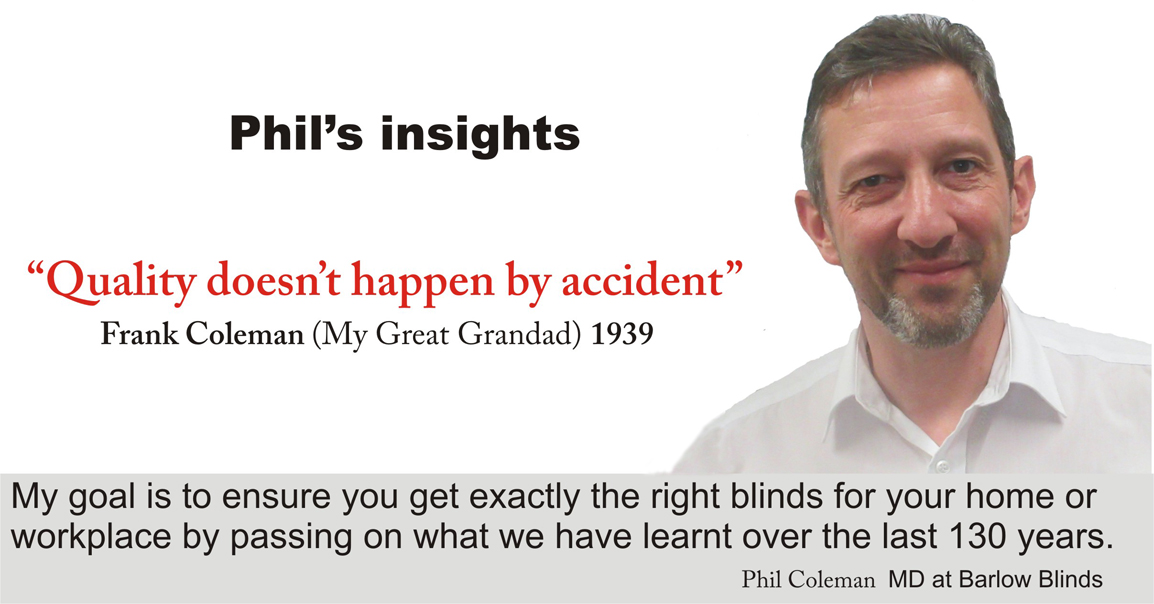
About Phil Coleman
Phil Coleman is the fifth generation of his family to run Barlow Blinds, a Leicester business that has been making blinds since 1887. With over 30 years of hands-on experience, Phil has played a leading role in shaping industry standards including being part of the team that wrote the only NVQ qualification for blind and shutter installers. He also serves on the Management Committee of the British Blind & Shutter Association (BBSA), helping to set best practice across the trade. Under his leadership, Barlow Blinds has remained true to its founding principle: “It’s not our job to find customers for our blinds, it’s our job to find the right blinds for our customers.”